You do not have to cover your blog with banners, pop-ups, and display ad units to earn money.
Learning how to monetize a blog without ads is mostly about changing what you monetize. Display advertising monetizes pageviews. An ad-free model can instead monetize expertise, recommendations, useful products, access, qualified leads, or the relationship you have built with returning readers.
That difference matters because the best revenue model for a blog with 500 highly motivated readers may be completely different from the best model for a general-interest site with 100,000 casual visits.
Rather than adding every monetization method you can find, start with one question: What useful next step would make sense for someone who has just benefited from this content?
That answer points you toward the right revenue stream.
Quick Answer: How Can a Blog Make Money Without Ads?
A blog can make money without display ads by connecting useful content to a relevant paid outcome.
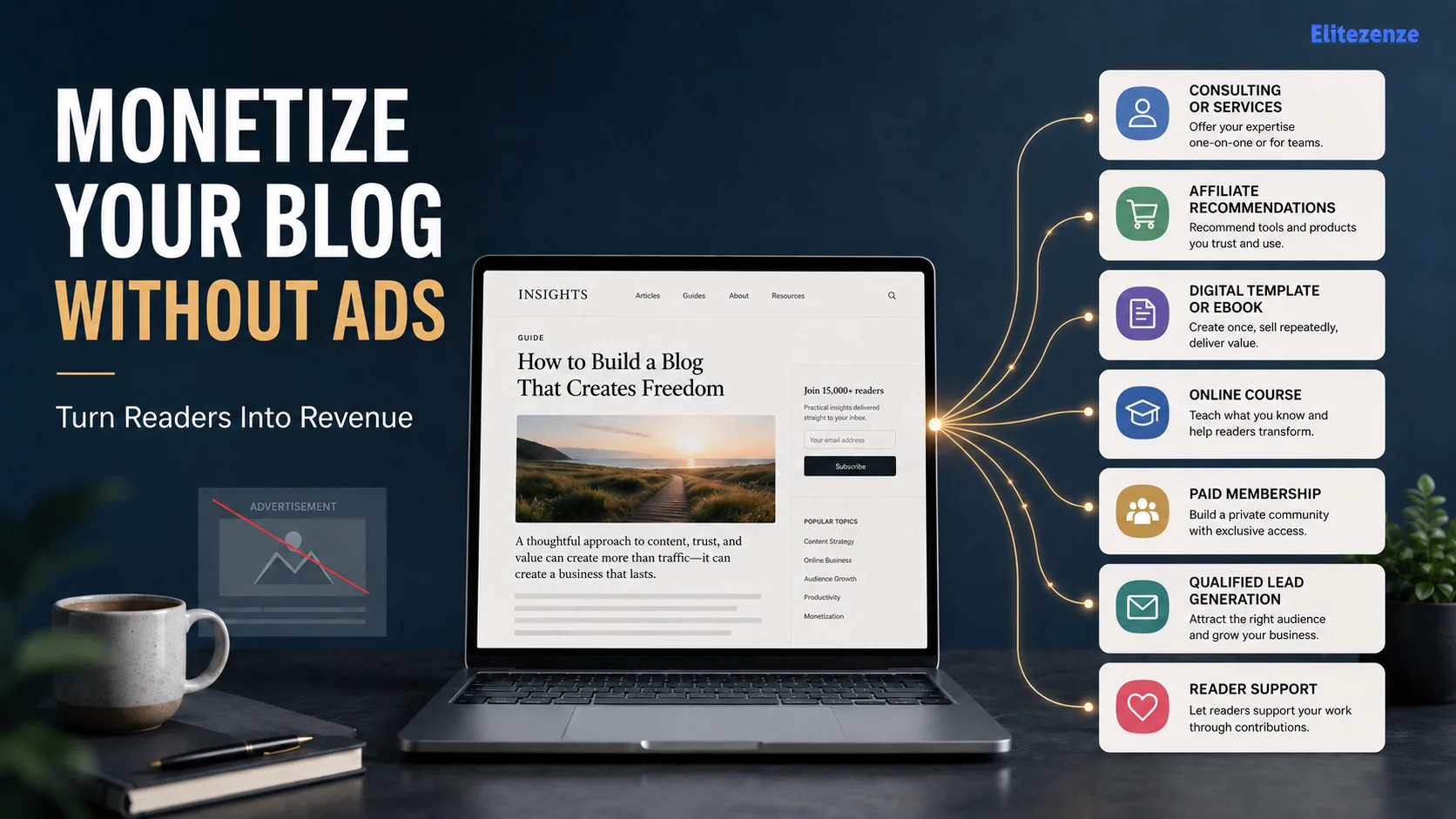
The eight most practical models are:
- Services or consulting
- Affiliate marketing
- Digital products
- Courses and workshops
- Memberships or paid newsletters
- Lead generation and referral fees
- Licensing or syndication
- Voluntary reader support
You do not need all eight. For most blogs, starting with one model that matches reader intent is more useful than building five unfinished income streams.

If your blog is still at the foundation stage, first make sure you have a focused audience and useful content worth monetizing. Elitezenze’s Blogging for Beginners 2026 guide covers that foundation.
First, Decide What “Without Ads” Means
There are two possible meanings.
No display ads means avoiding networks and banner placements while still allowing affiliate recommendations or sponsored partnerships.
No advertising at all is stricter. In that case, sponsorships and paid brand placements should also be excluded.
That distinction is often blurred in monetization guides. A sponsored article may look cleaner than a banner ad, but a company is still paying for promotional exposure.
Affiliate marketing differs in that payment is usually tied to a referral or a qualifying action rather than the mere placement of an ad. It still creates a financial relationship that readers may need to be aware of.
For example, U.S. FTC guidance says affiliate relationships should be disclosed clearly and conspicuously so readers can understand the financial connection. The guidance also notes that U.S. rules may apply to someone posting abroad when an effect on U.S. consumers is reasonably foreseeable. Requirements differ by jurisdiction, so check the rules that apply to your business and audience. Read the FTC’s affiliate disclosure guidance
This article focuses on models that can work without display advertising and keeps sponsorships outside the core eight because sponsorship itself is advertising.
Choose Your Monetization Model Before Adding Offers
Do not begin by asking, “Which method pays the most?”
Ask whether a method fits your readers and your ability to deliver it.
A simple four-part Monetization Fit Test works well.
1. Reader intent
Why did this person arrive?
Someone reading “best email marketing software for freelancers” is much closer to choosing a product than someone reading “what is email marketing?”
The first page may naturally support an affiliate recommendation. The second might work better for an email signup or beginner product.
2. Trust
Why should a reader take your recommendation or pay you?
Useful content can create trust, but your monetization claim still needs to be credible.
Do not recommend products simply because the commission is attractive.
3. Economics
What is one successful conversion worth?
One consulting client could be worth more than hundreds of small affiliate commissions. A $20 template requires different sales volume from a $300 workshop.
4. Capacity
Can you deliver the offer well?
A membership sounds attractive because revenue can recur, but members also expect recurring value.
Consulting can generate meaningful revenue with a small audience, but every new client consumes time.

Use these four factors together rather than choosing a monetization strategy because another blogger says it is the “best.”
8 Ways to Monetize a Blog Without Ads
1. Sell a service
Services are often a practical first monetization model when you have a useful skill but not yet a large audience.
Your blog acts as evidence that you understand the problem.
A marketing blog might generate:
- SEO consulting work;
- content strategy projects;
- copywriting clients;
- website audits;
- email marketing work.
A fitness professional might use articles to attract coaching clients. A designer could use tutorials to generate design inquiries.
The important part is the connection between the article and the service.
A post about improving landing-page conversions can naturally lead to a landing-page audit. A generic article about entrepreneurship is much less likely to do so.
If you are exploring service-based income more broadly, Elitezenze’s Home Business That Works guide offers additional business model ideas.
Best for: bloggers with a marketable skill.
Main limitation: revenue is tied partly to your available time.
2. Use affiliate marketing
Affiliate marketing lets you earn a commission or referral payment when a reader takes a qualifying action through your tracked link.
It works best when your article helps someone make a real purchase decision.
Strong affiliate content may include:
- detailed comparisons;
- alternatives;
- tutorials that use relevant tools;
- buyer guides;
- product roundups;
- “best for” recommendations.
The goal is not to insert the largest possible number of links. It is to help the reader make a better decision.
Google explicitly identifies “thin affiliation” as affiliate content that largely reproduces merchant descriptions without meaningful original value. Examples of useful affiliate sites include those that add original information, testing, ratings, or comparisons. See Google’s current guidance on affiliate content
That makes useful affiliate monetization and useful SEO point in the same direction: add decision value.
For more context on where affiliate marketing fits in the wider marketing ecosystem, see Elitezenze’s Affiliate Marketing vs Digital Marketing guide.
Best for: articles with clear product- or service-buyingintent.
Main limitation: the merchant controls commissions, terms, and often the customer relationship.
3. Sell a digital product
A digital product turns a repeated reader problem into something people can buy and use.
Examples include:
- templates;
- spreadsheets;
- checklists;
- ebooks;
- swipe files;
- calculators;
- planners;
- research packs;
- premium guides.
Start with the problem, not the format.
If readers repeatedly ask, “Can you give me the spreadsheet you use for this?” you may have product demand.
If nobody has shown interest in a 200-page ebook, spending two months creating one is a much bigger gamble.
One useful approach is to build the smallest version that solves the entire problem, sell it, collect feedback, and improve it.
Best for: blogs where readers repeatedly need the same reusable solution.
Main limitation: product creation is scalable only after you have validated demand and built a way to sell it consistently.
4. Create a course or paid workshop
Use a course when the buyer needs a sequence, not simply a file.
A template might help someone execute one task. A course can guide them through a transformation involving several decisions and skills.
Before recording 30 video lessons, consider running the idea as a live workshop.
A live version tells you:
- whether people will pay;
- which questions keep appearing;
- where students get stuck;
- which examples are most useful.
You can then decide whether a larger course is justified.
Best for: subjects where readers want to develop a skill or complete a multi-step outcome.
Main limitation: creating content is only part of the job; students may also expect updates and support.
5. Offer a membership or paid newsletter
Subscriptions are attractive because revenue can recur, but recurrence works both ways: the obligation to deliver also recurs.
A paid membership makes sense when readers have a continuing need rather than a problem they solve once.
Possible offers include:
- premium research;
- member-only tutorials;
- recurring templates;
- industry analysis;
- community access;
- office hours;
- premium newsletters.
The free blog remains the discovery engine while the membership provides continuing depth or access.
Stripe’s current publisher-monetization overview similarly distinguishes subscriptions from advertising and describes memberships as a direct revenue relationship with readers. See Stripe’s publisher monetization overview
Best for: blogs with loyal returning readers and a recurring need for information
Main limitation: churn and ongoing delivery.
6. Generate qualified leads or referrals
Some blogs are more valuable as lead generators than as publishing businesses.
Imagine a blog read by business owners researching accounting software implementation.
Instead of earning a small amount for displaying an ad, the publisher might connect qualified prospects with an appropriate consultant or service provider, subject to applicable disclosure, contractual, and legal requirements.
Lead generation works particularly well in B2B and service categories, where a single customer can be highly valuable.
The content should qualify rather than merely attract.
Articles about implementation cost, comparisons, mistakes, and vendor selection tend to reveal more commercial intent than broad awareness posts.
Elitezenze’s B2B Blog Best Practices guide explains how blog content can support a lead-generation journey.
Best for: specialized B2B and professional-service audiences.
Main limitation: lead quality matters far more than raw lead count.
7. License or syndicate original content
If you create genuinely valuable original material, another organization may be willing to pay for permission to use it.
Possibilities include:
- original research
- industry datasets
- graphics
- photography
- training material
- specialist explainers
- proprietary calculators
- editorial packages
This is a more advanced monetization method because there must be something sufficiently distinctive to license.
Repackaging generic information rarely creates much licensing value.
Best for: publishers producing defensible intellectual property.
Main limitation: creating licensable material usually requires substantial original work.
8. Accept voluntary reader support
Some blogs serve audiences that appreciate the work but do not naturally buy a product.
A voluntary support option can provide a simple way to contribute.
This is most appropriate when readers already receive substantial value and want the publication to continue.
It should not be confused with a strong commercial business model. Contributions can fluctuate, and many readers will never pay voluntarily.
Think of it as a supplementary revenue stream rather than the default solution for a new blog.
Best for: highly engaged communities and public-interest or enthusiast publishing.
Main limitation: unpredictable revenue.
Can You Monetize a Blog With Low Traffic?
Yes, but “low traffic” does not mean “no audience.”
You still need someone to see the offer.
The mistake is assuming that pageviews alone determine monetization.
A more useful equation is:
Revenue ≈ qualified visitors × conversion rate × net value per conversion

Consider three completely hypothetical examples using 1,000 monthly readers:
| Model | Illustrative assumptions | Illustrative revenue |
|---|---|---|
| Affiliate | 100 clicks × 3% purchase rate × $20 commission | $60 |
| $29 product | 2% of 1,000 visitors buy | $580 before fees/refunds |
| Service | 20 enquiries × 20% close × $250 project | $1,000 |
These are not benchmarks or earnings predictions. The numbers are deliberately hypothetical.
They demonstrate why asking “How many views do I need?” is incomplete. The answer changes with intent, conversion,n and customer value.
A 2026 Productive Blogging survey gives another useful reality check. Among 129 self-selected respondents, 26% reported earning some income from blogging. The reported median time to first income was 12 months, while the mean was about 21 months. The publisher notes that the sample skews toward English-speaking, monetization-focused bloggers, so these figures should not be treated as a promise. See the 2026 Blogging Income Survey methodology and results
Build One Simple Blog Monetization Funnel
A blog does not earn merely because an affiliate link or checkout button exists.
A useful monetization path looks more like this:

Start by looking at your existing articles.
For each page, ask:
What is this reader probably trying to do next?
A reader comparing software may want a recommendation.
A reader struggling to execute a complex task may want help.
A reader repeatedly rebuilding the same document may want a template.
A regular reader following an evolving topic may value a premium newsletter.
Then give that page one clear primary next step.
Do not make readers choose between a course, six affiliate products, a consultation, three ebooks, and two pop-ups at the same time.
Email can help connect several visits, but an email list is best treated as a distribution and relationship channel, not automatically as a monetization model on its own. The money still comes from an offer such as a product, membership, affiliate recommendation,n or service.
Measure Whether Your Monetization Is Working
Do not evaluate monetization solely by total monthly revenue.
Track enough information to understand why the revenue happened.
Revenue per visitor
RPV = net revenue ÷ visitors
This lets you compare different monetization approaches more fairly.
Offer conversion rate
How many people who reached the offer actually purchased or enquired?
Affiliate earnings per click
Do not stop at affiliate-link clicks. Find out whether those clicks create meaningful commissions.
Lead-to-client rate
If services are your model, inquiries are not the final result. Track how many become customers.
Refund or cancellation rate
A product generating lots of sales but lots of refunds may have a positioning or quality problem.
A membership that gains 100 subscribers and loses 90 quickly has a retention problem.
The objective is not maximum monetization on every page. It is sustainable revenue without weakening the reason readers trusted the blog in the first place.
A 30-Day Ad-Free Monetization Plan

Week 1: Choose
Review your highest-intent pages.
Identify the problem readers are trying to solve after reading them.
Choose one revenue model using the Intent → Trust → Economics → Capacity test.
Week 2: Build
Create the smallest complete version of the offer.
For affiliates, identify a small number of genuinely relevant programs or products.
For services, create a clear service page.
For digital products, build a minimum useful product rather than an enormous package.
Week 3: Connect
Add contextual calls to action to your strongest relevant content.
Do not automatically add the offer to every post.
Make required disclosures clear.
Test checkout, forms, tracking, and delivery yourself before sending readers through them.
Week 4: Measure
Review:
- offer views;
- clicks;
- enquiries;
- purchases;
- net revenue;
- refunds;
- reader feedback.
If nobody clicks, your offer or placement may be wrong.
If people click but do not buy, examine positioning, price, trust, and offer fit.
If customers buy but are dissatisfied, stop optimizing the sales page and fix the product.
Run another cycle using what the data taught you.
Common Blog Monetization Mistakes
The first is trying to monetize everything.
A purely informational article does not always need a sales pitch.
The second is choosing products based primarily on commission size. A high commission does not make an irrelevant recommendation useful.
The third is building before validating. A small paid workshop can test demand before you record a large course.
Another mistake is calling every monetization method “passive.” Affiliate links need updates. Products need marketing and support. Memberships need retention. Even an automated business still needs management.
Avoid hiding affiliate relationships. Trust is difficult to build and easy to damage.
Finally, do not add six revenue models because diversification sounds sophisticated.
First make one model work.
Then consider a second model that reduces concentration risk or serves a different reader need.
Frequently Asked Questions
Can a blog really make money without ads?
Yes. A blog can earn through services, affiliate referrals, digital products, courses, memberships, lead generation, licensing,g and voluntary reader support. The right choice depends more on the reader’s intent and fit than on simply choosing the most popular method.
How many visitors do I need to monetize a blog?
There is no universal minimum for most non-ad monetization methods. A specialized service may generate revenue from a relatively small number of qualified visitors, whereas low-value offers may require much higher traffic. Evaluate traffic, conversion rate, and value per customer together.
What is the easiest blog monetization method for beginners?
If you already have a marketable skill, offering a focused service can be relatively simple to validate. If readers visit your content specifically to compare products or tools, affiliate marketing may be a more natural starting point.
Can I monetize a blog without affiliate marketing?
Yes. You can sell services, digital products, courses, memberships, qualified leads, licensing rights, or other products you own. Affiliate marketing is optional.
Are sponsorships considered ad-free monetization?
Not strictly. Sponsorships can replace automated display ads, but paid sponsored content is still promotional advertising. Any material relationship should be handled transparently and in accordance with applicable rules.
Should I use affiliate marketing or sell my own product?
Use affiliate marketing when a good solution already exists, and readers need help finding or evaluating it. Consider your own product: when readers repeatedly need a solution, you can create and support it better yourself.
Should I monetize a new blog immediately?
You can plan monetization from the beginning, but usefulness should come first. Establish a focused audience problem and useful content, then test one small, relevant offer rather than adding multiple revenue streams immediately
Final Takeaway
The best way to monetize a blog without ads is not to find the revenue stream with the biggest income screenshot.
Find the next problem your reader is already trying to solve.
Then choose one offer that solves it, place that offer where the intent exists, measure what happens,ns and improve from real behavior.
A smaller blog with a clear audience, strong trust, and a relevant offer can build a viable revenue system long before it needs to turn every pageview into an advertising impression.