Starting a blog is easier than it used to be. Getting people to care about it is the harder part.
That is the reality of blogging for beginners 2026. You can buy a domain, choose a platform and publish your first article in a day. But building a blog that earns attention, search visibility and repeat readers requires more than simply putting posts online.
The good news is that the basics still work. A focused topic, genuinely useful content, solid SEO, smart promotion and consistent improvement can still build a valuable audience.
What has changed is the environment around those basics. Your articles can now be discovered through traditional Google results, AI Overviews and AI Mode, social platforms, newsletters and other recommendation systems. At the same time, generic articles are easier than ever to produce, which makes original experience and useful analysis much more important.
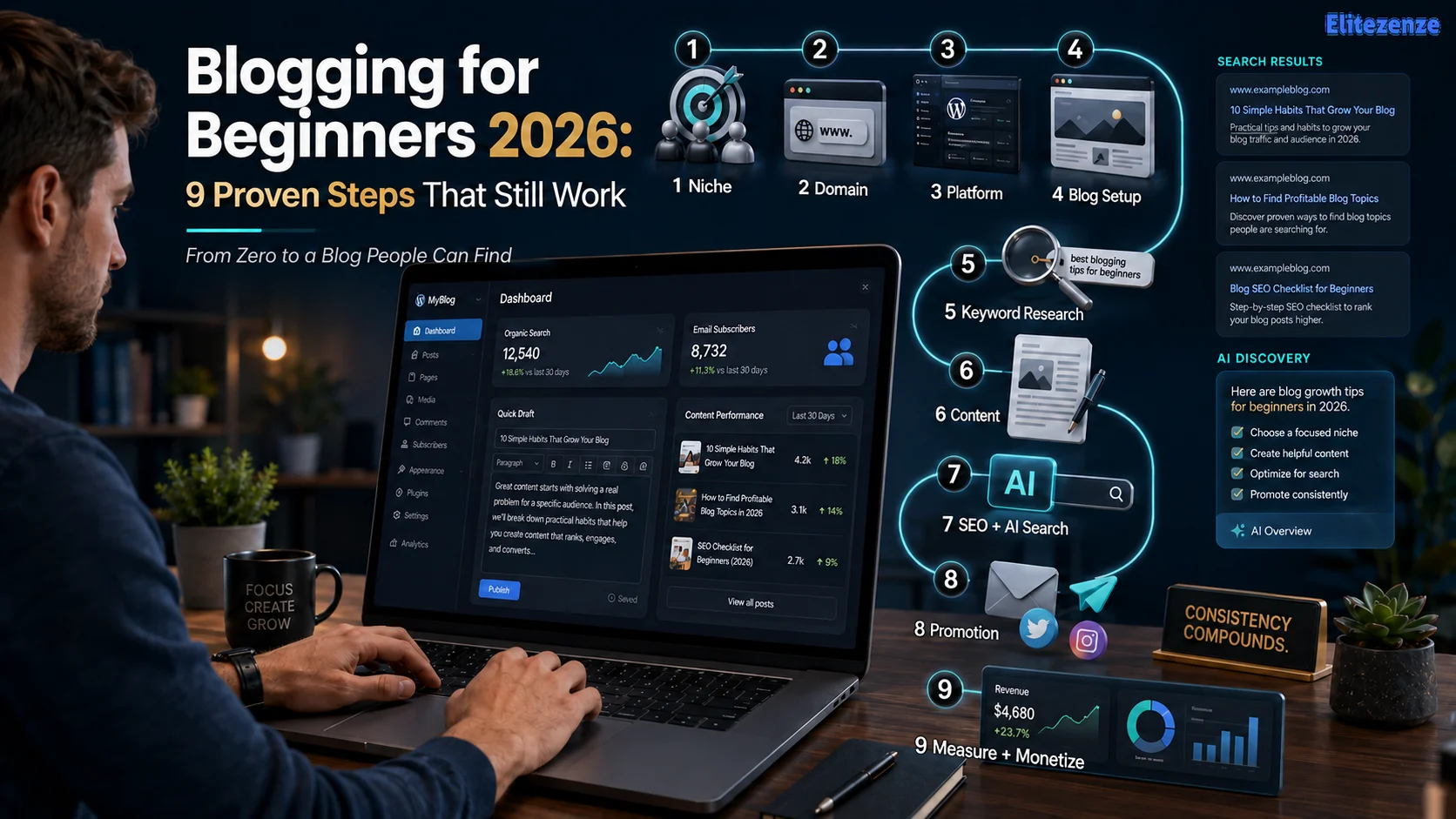
This guide walks you through nine practical steps for starting a blog in 2026 without turning the process into something more complicated than it needs to be.
Quick Answer: How Do You Start Blogging in 2026?
To start a blog in 2026, choose a focused niche, understand the audience you want to help, select a domain and blogging platform, build a simple website, research the questions people are searching for, publish genuinely useful articles, optimize them for search, promote them through relevant channels and use performance data to improve what works.
In simple terms:
Niche → Domain → Platform → Website → Research → Content → SEO → Promotion → Measurement
You do not need dozens of tools or hundreds of articles before you can begin.
What Is Blogging in 2026?
Blogging is the process of publishing useful, regularly updated content on a website for a specific audience.
But a modern blog can do much more than hold articles.
It can become your searchable knowledge library, personal or business brand, email-list growth channel, source of leads and eventually a platform for earning revenue.
That matters because you own the website itself. A social platform can change its algorithm or reduce your reach. Your blog gives you a central place where your content, brand and audience relationships can develop over time.
What Has Changed About Blogging?
The biggest change is how people discover information.
Traditional search still matters, but it now exists alongside AI-powered search experiences, social discovery, video, newsletters and communities.
Google’s own 2026 guidance says traditional SEO practices remain relevant to generative AI features such as AI Overviews and AI Mode. It also emphasizes unique, valuable and non-commodity content rather than special “GEO hacks.”
For the official explanation, see Google’s generative AI Search optimization guide.
Is Blogging for Beginners in 2026 Still Worth It?
Yes—but not if your plan is simply to generate hundreds of generic articles and hope Google sends traffic.
The blogs worth building today usually have a clear reason to exist. They help a recognizable group of people solve specific problems, make decisions, learn something or benefit from first-hand knowledge.
What still works?
Focused niches. Useful evergreen articles. Long-tail topics. Original examples. Strong internal linking. Email subscribers. Content updates. Genuine expertise. Consistency.
What is becoming less useful?
Keyword stuffing, rewriting the first five Google results, publishing shallow AI content, chasing every trending topic and expecting passive income after a handful of posts.
Google’s current guidance specifically recommends creating unique, people-first content that adds value beyond information already available elsewhere.

Step 1: Choose a Focused Blog Niche and Specific Reader
A niche gives your blog direction. More importantly, it helps readers understand whether your site is meant for them.
Do not choose a niche only because someone calls it profitable.
A better approach is to look for the intersection of three things:
What you understand + what you can keep talking about + what people genuinely need help with
Then make the audience more specific.
“Fitness” is broad.
“Simple home workouts for busy beginners over 40” immediately tells you who you are helping and what kind of content belongs on the site.
“Travel” is broad.
“Affordable weekend travel for Indian couples” gives you a much clearer editorial direction.
Before committing to a niche, investigate the questions people ask, the communities they participate in, the products or services they spend money on and the quality of existing information.
Most importantly, ask yourself:
What can I contribute that another generic website cannot?
It could be professional knowledge, personal experiments, local experience, original research, useful examples or simply an unusually clear way of teaching something complicated.
That answer can become part of your competitive advantage.
Step 2: Choose a Memorable Blog Name and Domain
Your domain does not need your main keyword squeezed into it.
A good blog name should be easy to say, easy to spell, easy to remember and broad enough to survive if your content expands later.
Try what I call the five-second domain test:
Can someone hear the name once and type it correctly five seconds later?
A name such as bestcheapbloggingtips2026.com might describe a topic, but it is awkward as a long-term brand. A short, distinctive name gives you more freedom.
Before registering anything, also check whether similar brands or trademarks already exist. You do not want to spend months building recognition around a name you cannot safely use.
Step 3: Choose the Right Blogging Platform and Hosting
Your blogging platform is the system you use to create, organize and publish content.
For most beginners, the main decision is between a managed website builder and a system such as WordPress.
There is no universal winner.
A hosted platform can be easier because much of the maintenance is handled for you. A self-hosted setup can offer more flexibility and control but may require more involvement with hosting, security, backups and technical maintenance.
A beginner usually needs only:
- A domain
- A reliable place to host the site
- SSL/HTTPS
- A content management system
- A responsive theme
- Basic backup and security protection
Do not spend three weeks comparing tiny differences between hosting packages while publishing nothing.
Your first platform needs to be reliable enough for you to learn and flexible enough for the next stage of the site.
If you choose WordPress.com, its official beginner blogging course covers themes, first posts, homepages, content organization and audience growth. Its current setup documentation also confirms that beginners can start with a WordPress.com address and move to a custom domain.
Step 4: Build a Fast, Simple and Trustworthy Blog
A beginner blog does not need ten animations, six fonts and a homepage that looks like a software dashboard.
It needs to be comfortable to read.
Start with the essential pages:
Home, About, Blog, Contact, Privacy Policy and any disclosure pages your situation requires.
Use clear navigation so a new reader can understand your major topics without hunting through menus.
Pay attention to mobile users. Keep typography readable. Use enough white space. Compress large images. Avoid aggressive popups that block the article before someone has read the first paragraph.
Trust matters as well.
Where appropriate, show a real author name, useful author biography, publication or update dates, sources for factual claims and an explanation of why you are qualified to discuss the subject.
You do not need to pretend to be an expert in everything.
In fact, “I tested this for 30 days and here is what happened” can be more useful than pretending you have ten years of expertise you do not actually have.
Google’s Search Essentials also makes clear that meeting technical requirements alone does not guarantee crawling, indexing or rankings. Quality and usefulness still matter.

Step 5: Research Search Intent and Build a Topic Map
Keyword research is useful, but starting with search volume alone can send a new blogger in the wrong direction.
Start with problems.
What does your ideal reader want to know?
What confuses them?
What decision are they trying to make?
What would they search immediately before needing your article?
Then look at the query, search intent, competition and—most importantly—what existing pages fail to explain.
Long-tail keywords are particularly useful for new blogs because they usually reveal a more specific need.
For example:
Broad: blogging
More specific: how to start a food blog
Clear beginner intent: how to start a food blog with no experience
Do not create a separate low-value article for every tiny keyword variation. Instead, build clusters of genuinely related content.
A beginner-blogging cluster might look like this:
Pillar guide: Blogging for Beginners
Supporting articles:
- How to choose a blog niche
- How to set up WordPress
- Keyword research for new bloggers
- How to write your first blog post
- Beginner blog SEO
- How to get your first readers
- Ways to monetize a blog
Those articles can naturally link to one another.
Before launching, try planning your first ten useful posts. You do not have to write all ten immediately. The exercise simply tells you whether your niche has enough depth to become a real publication rather than a one-article idea.

Step 6: Write Original Blog Posts People Actually Want to Read
The first job of a blog post is not to impress an algorithm.
It is to help the person who opened the page.
Answer the main question early. Then earn the reader’s attention by making the answer clearer, deeper or more practical.
A useful structure is:
Answer → Explanation → Example → Evidence → Next Action
Suppose someone searches for how often a beginner should publish.
They probably do not want 600 words about “the rapidly evolving digital landscape” before reaching an answer.
Tell them what matters, explain the tradeoffs, then give them something they can use.
Originality also matters more when almost anyone can produce a generic article in seconds.
Add things competitors cannot reproduce easily:
Your screenshots. Your process. A mistake you made. Results from something you tested. A template you built. A comparison you performed. Original photographs. A small dataset. An expert interview. A practical example from your work.
That does not mean AI tools must be avoided.
They can be useful for brainstorming, organizing research, identifying gaps, creating rough structures or helping edit awkward wording.
But using AI to produce 100 thin articles is not the same as building a useful publication. Google specifically warns that generating large amounts of content without adding user value may violate its scaled-content-abuse policies.
Use AI to assist your thinking—not to manufacture experience you do not have.
Step 7: Optimize Every Post for SEO and AI Search
You do not need two completely separate systems called “SEO” and “GEO” for Google.
Google’s May 2026 guidance is unusually direct on this point: the foundations of SEO remain the foundations for its generative AI Search experiences.
Start with practical on-page basics:
Useful title → clean URL → one clear H1 → direct introduction → descriptive H2/H3 sections → relevant images → useful internal links → trustworthy sources → satisfying conclusion
Use the main keyword where it naturally clarifies the topic, but do not chase a magic percentage.
Your article should also contain the related language a real person would expect. A guide about blogging may naturally discuss domains, hosting, search intent, content strategy, internal linking, traffic, subscribers and analytics without forcing every phrase into a sentence.
For answer and AI visibility, clarity helps.
Use concise definitions when a definition is needed. Make steps easy to identify. Use tables where comparisons are genuinely easier in table form. Clearly attribute statistics and claims. Keep important information in readable text rather than hiding everything inside graphics.
Google says pages do not need special AI markup, AI text files or special schema simply to appear in AI Overviews or AI Mode. Pages still need to be indexed and eligible for normal Google Search.
That is much simpler than many “AEO hacks” make it sound.

Step 8: Promote Every Post and Start Building an Email Audience
Publishing is the beginning of distribution, not the end.
When a new article goes live, think about where the right readers already spend time.
That could include search, your email subscribers, YouTube, Pinterest, LinkedIn, Facebook communities, Reddit or a specialist forum.
You do not need all of them.
Choose one or two channels that match your niche and learn how those communities actually communicate. Dropping your link everywhere is promotion in the weakest sense. Participating usefully and sharing an article when it genuinely answers the discussion is far more sustainable.
Start building an email list early too.
Search engines and social networks are valuable discovery channels, but you do not control their distribution systems. An email subscriber has actively chosen to hear from you again.
Give readers a reason to subscribe.
A useful checklist, template, short email course, calculator or resource library is usually more compelling than a generic “subscribe for updates” box.
Links from other websites can also help discovery and authority, but focus on creating things worth citing rather than chasing random backlinks.
Original research, strong tutorials, free tools, templates, statistics pages and useful visual frameworks naturally give other publishers a reason to reference you.
Step 9: Measure, Update and Monetize What Works
A blog becomes easier to improve once you stop guessing.
Connect Google Search Console and an appropriate analytics platform. Then look beyond raw pageviews.
Track questions such as:
Which pages receive impressions?
Which searches bring visitors?
Which articles are close to stronger search positions?
Where do readers subscribe?
Which topics create inquiries, sales or other conversions?
Which pages are losing visibility?
In June 2026, Google announced dedicated Generative AI performance reports in Search Console, initially rolling them out to a subset of websites. The reports provide information such as impressions, pages, countries, devices and dates for visibility within generative AI features.
If the report is available for your site, it gives you another way to understand discovery. If it is not available yet, that does not stop you from using the standard performance data already available.
Do not assume growth requires constantly creating new URLs.
Sometimes the best next move is updating an article that already performs.
Refresh outdated screenshots. Replace broken links. Improve examples. Add information readers are now looking for. Rewrite a weak introduction. Strengthen internal links. Remove sections that no longer help.
Monetization can come after you understand the audience.
Depending on the niche, that might include affiliate marketing, services, sponsorships, advertising, memberships or digital products.
There is no guaranteed income timeline. A monetization method works only when it fits the audience, traffic and level of trust you have actually built.
5 Blogging Mistakes Beginners Should Avoid in 2026
1. Picking a Niche Only Because It Looks Profitable
If you cannot contribute anything useful to the topic, sustaining the blog becomes difficult.
2. Publishing Generic AI Content
AI can accelerate a workflow. It cannot supply first-hand experience you never had.
3. Writing About Unrelated Topics
A clear body of related content is easier for readers to understand and easier to navigate.
4. Depending Entirely on Google
Develop email and at least one additional discovery channel so your audience is not tied to a single source.
5. Quitting Before You Have Enough Evidence
A handful of posts rarely gives you enough information to judge an entire blogging strategy. Publish consistently, measure what happens and make decisions from actual data instead of expectations.
Blogging for Beginners 2026 FAQ
Is blogging still worth it in 2026?
Yes, blogging can still be worthwhile when you have a defined audience and something genuinely useful to contribute. What is becoming less effective is publishing generic information that readers can find in hundreds of other places.
How much does it cost to start a blog in 2026?
There is no single correct number. You can begin on some platforms with a free subdomain, while a professional setup may involve a custom domain, hosting, premium themes, email software or other tools. Check current provider prices before publishing a specific cost figure because plans and renewal rates change frequently.
Can I start blogging with no experience?
Yes. You do not need years of professional experience to document what you are learning. You do, however, need to be honest about what you know, research factual claims carefully and avoid presenting yourself as an expert when you are not one.
What is the best blogging platform for beginners in 2026?
The best platform depends on your goals. Hosted platforms can reduce technical maintenance, while more flexible systems may suit bloggers who want greater control and customization. Choose based on your expected workflow rather than another blogger’s affiliate recommendation.
How many blog posts should a beginner publish?
There is no magic number. A sustainable schedule that allows you to publish useful, well-researched content is more valuable than forcing yourself to hit an arbitrary daily or weekly quota.
How long does it take a new blog to get traffic?
There is no guaranteed timeline. Search competition, content quality, site authority, indexing, promotion, niche demand and your existing audience can all affect how quickly a blog gains readers.
Can beginners make money blogging in 2026?
Yes, but income is not guaranteed. Bloggers may eventually earn through services, affiliate partnerships, advertising, sponsorships, memberships or their own products. The right model depends on the audience and the trust you have built.
Should beginners use AI to write blog posts?
AI can help with research organization, brainstorming, editing and outlining. It should not be used to invent expertise, sources, quotations, results or experiences. Google’s guidance focuses on the usefulness and quality of the finished content rather than giving AI-generated material a special shortcut to rankings.
Final Takeaway: Start Small and Become Useful
The most important lesson in blogging for beginners 2026 is simple: you do not need to become the biggest publisher in your niche. You need to become useful enough that the right readers want to return.
Choose a clear audience. Answer real questions. Add experience and evidence competitors cannot easily copy. Build an email relationship. Learn basic SEO. Watch what readers respond to and improve your strongest work.
Your first practical task is not buying ten tools.
Choose your niche and write down the first 10 questions your ideal reader genuinely needs answered.