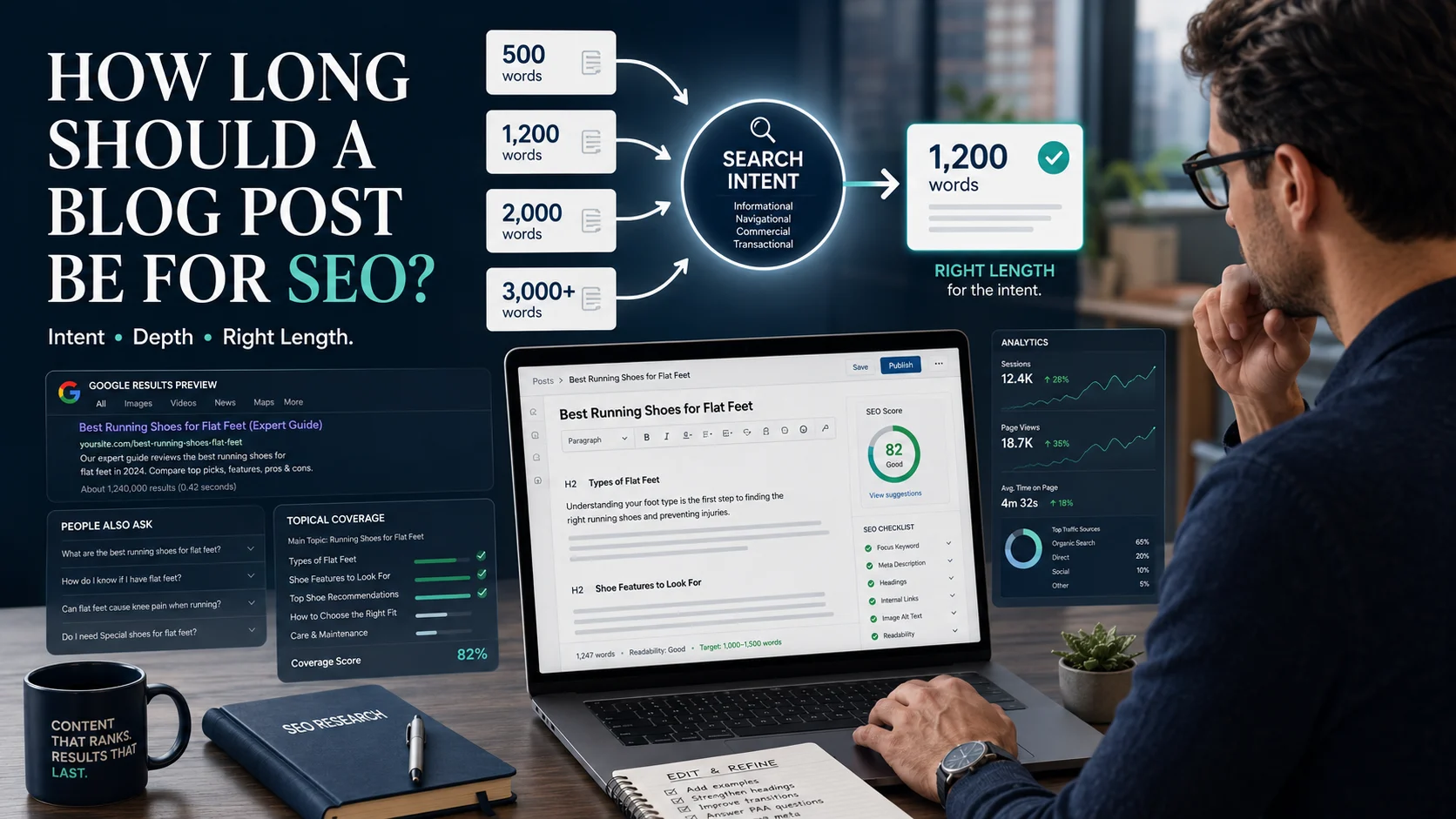
If you are wondering how long a blog post should be for SEO, here is the most useful answer: there is no word count that Google requires or automatically rewards.
For many substantial informational topics, a range of 1,200–2,500 words is a reasonable planning range. But a focused 700-word article may be exactly right for one query, while another topic genuinely needs 3,000 words or more.
The mistake is treating the number as the goal.
Your goal is to answer the searcher’s question completely and clearly, without adding paragraphs to make the article longer.
This guide will show you how to estimate the right length before writing, recognize when a draft is too short or too long, and create a realistic word-count target for almost any topic.
How Long Should a Blog Post Be for SEO? The Short Answer
For many informational SEO articles, 1,200–2,500 words is a useful starting range, not a rule.
Different types of content naturally need different lengths:
| Content type | Useful starting range |
|---|---|
| Simple definition or narrow answer | 300–700 words |
| News/update | 400–900 words |
| Focused tutorial | 800–1,500 words |
| Standard informational article | 1,200–2,000 words |
| Detailed how-to guide | 1,500–2,500 words |
| Comparison/decision guide | 1,500–3,000 words |
| Broad pillar resource | 2,500–4,000+ words |
These ranges should help you plan. They should never become quotas.

A question such as “What does bounce rate mean?” may be fully answered in several hundred words.
A guide explaining how to conduct an SEO audit could require thousands of words, screenshots, examples, checklists, and links to specialized supporting articles.
The right question is therefore not:
How many words does Google want?
It is:
How much useful information does this searcher need?
Does Word Count Affect SEO Rankings?
Word count is not a Google ranking requirement.
Google’s people-first content guidance explicitly asks creators whether they are writing to a particular word count because they have heard Google prefers one—and then makes clear that Google does not have such a preferred word count.
You can read the primary guidance in Google’s people-first content documentation.
That does not make length irrelevant.
Length can result from characteristics that are valuable.

A detailed article may naturally:
- answer more relevant questions
- provide stronger examples
- explain exceptions
- cite better evidence
- compare alternatives
- include useful instructions
- attract links because it becomes a reference
Those things can make the page more useful.
Adding another 700 words of repetition does not.
What ranking studies really tell us
Backlinko’s analysis of 11.8 million Google results reported an average of about 1,447 words among first-page results. But the study also reported that word count was relatively evenly distributed among positions on the first page.
That distinction matters.
It would be incorrect to turn the study into:
“Google wants 1,447-word articles.”
A better interpretation is:
Detailed pages frequently appear in competitive search results, but their success cannot be attributed to word count alone.
Orbit Media’s 2025 survey adds another useful benchmark. The surveyed bloggers and content marketers were publishing articles averaging 1,333 words. Again, that describes publishing behavior; it does not establish an SEO minimum.
The safest conclusion is simple:
Treat word count as a planning metric, not a ranking factor.
Ideal Blog Post Length by Content Type
The type of page you are creating is one of the best predictors of its natural length.
Short answers: roughly 300–700 words
Shorter content works when the reader’s question has a narrow scope.
Examples:
- What is a canonical URL?
- What does CPM mean?
- How do I change my WordPress timezone?
Do not turn a simple answer into 1,800 words because your SEO tool displays an arbitrary target.
Focused tutorials: roughly 800–1,500 words
A tutorial needs enough room to explain:
- what the reader needs
- the steps
- common mistakes
- what the finished result should look like
Screenshots or video can sometimes replace several paragraphs of explanation.
Standard informational articles: roughly 1,200–2,000 words
This is where many traditional blog topics naturally fall.
A reader may have one central question plus several related concerns that need enough explanation to make the main answer useful.
Comprehensive guides: roughly 1,500–2,500+ words
Complex guides often need:
- definitions
- preparation
- processes
- examples
- troubleshooting
- alternatives
- limitations
- next steps
The length is justified because the task is larger, not because the article receives an SEO bonus at 2,000 words.
Pillar resources: 2,500–4,000+ words when genuinely necessary
Broad pillar pages may cover the major branches of a subject and direct readers to narrower supporting articles.
But even pillar pages need boundaries.
If a 6,000-word article contains three sections that each address different search intents, creating separate supporting pages may provide readers with a cleaner experience.
Semrush similarly separates recommended ranges by content format rather than prescribing a universal number.
Five Factors That Determine How Long Your Blog Post Should Be
Use these factors instead of choosing an arbitrary target.
1. Search intent
Search intent is the job the reader expects the page to perform.
Someone searching:
“What is keyword cannibalization?”
primarily needs an explanation.
Someone searching:
“How to fix keyword cannibalization”
needs diagnosis, decision criteria, instructions, examples, and possibly tool guidance.
Similar topic. Different job. Different natural length.
Before writing, complete this sentence:
After reading this page, the visitor should be able to __________.
If you cannot clearly fill that blank, deciding the article length will be difficult.

2. Topic scope
Broad topics naturally require more information.
Compare:
“How to write a blog post”
with:
“How to write a blog post introduction.”
The second topic can remain tightly focused. The first may need research, structure, drafting, editing, SEO, visuals, publishing, and promotion.
Do not confuse a broad keyword with a single question.
3. Reader knowledge
Beginners often need more context.
An experienced SEO specialist may understand phrases such as canonicalization, crawl budget, schema markup, and search intent without definitions.
A beginner audience may need short explanations before acting on the instructions.
That additional context increases length legitimately because it reduces confusion.
4. Evidence and examples
Some claims can be stated in one sentence.
Others require:
- a source
- explanation of what the data measures
- limitations
- an example
- an exception
Evidence makes content longer, but more importantly, it makes it trustworthy.
Do not remove necessary evidence to reach a shorter word count.
5. Current search results
The SERP is useful because it reveals what Google currently considers relevant to the query.
But do not simply calculate:
Competitor A: 2,100 words
Competitor B: 2,500 words
Competitor C: 2,300 words
Therefore: I need 2,301 words.
Instead, inspect why each page is that long.
Look at:
- which questions repeatedly appear
- which questions are unnecessary
- how broad each page is
- whether videos or tools replace text
- whether pages combine multiple intents
- where explanations feel incomplete
Use competitors to discover the expected scope, not an exact quota.
A 5-Step Method to Choose the Right Blog Post Length
Here is a process you can repeat before writing any SEO article.
Step 1: Define the reader’s job
Write the main task in one sentence.
For this article:
Help a blogger determine an appropriate length for an SEO-focused blog post without relying on a fake universal word-count rule.
That immediately tells us the article needs more than a one-paragraph answer. The reader needs both an answer and a method.

Step 2: Build a necessary-question map
List the questions someone must understand before the main problem feels solved.
For example:
- Is word count a ranking factor?
- Why do people recommend 1,500–2,500 words?
- What lengths work for different article types?
- How should I evaluate competitors?
- How do I know when I have written enough?
- Can an article become too long?
Notice the word necessary.
Do not add a section merely because a keyword tool discovered another related phrase.
Step 3: Inspect comparable search results
Review perhaps five to ten genuinely comparable pages.
Exclude pages serving a different intent.
If eight ranking pages are full guides but one result is a 250-word glossary entry, averaging all nine word counts provides little value.
Instead ask:
What level of explanation does this SERP expect?
Step 4: Set a range, not an exact number
Suppose your research suggests the article probably requires about 1,600 words of useful explanation.
Your brief might say:
Expected range: 1,400–1,900 words
That gives the writer enough structure without forcing them to stretch a complete 1,450-word article to 1,900.
For a complex topic, you might plan:
2,000–2,800 words
Again, it is a budget, not a requirement.
Step 5: Forget the number while drafting
Once the brief is ready, write the article for the reader.
Then compare the finished draft against the range during editing.
If it is shorter, ask:
What useful question is missing?
Do not ask:
How can I add 400 words?
If it is much longer, ask:
Which sections are repetitive, off-intent, or worthy of their own article?
That keeps word count in its proper role.
How Do You Know When a Blog Post Is Long Enough?
Your article is probably long enough when the reader can complete the intended task without needing another article to fill in basic missing information.
Run this checklist:
- Did I answer the main question near the beginning?
- Did I explain the reasoning behind the answer?
- Did I cover important exceptions?
- Did I include evidence for claims that need evidence?
- Did I provide at least one useful example where explanation alone could be misunderstood?
- Did I answer the obvious next questions?
- Can a reader take the intended next action?
- Am I now repeating points instead of adding new information?

That last question is your stopping signal.
Completeness is good. Repetition is not depth.
When a Shorter Blog Post Is Better
Short content can be the superior format when:
- the query has one clear answer
- freshness matters more than comprehensiveness
- the reader needs an update
- the content supports a larger guide
- images or video carry much of the explanation
- extending the article would only create repetition
Imagine someone searches:
“Can I change a WordPress post URL after publishing?”
The reader probably needs the answer, the risks, a short redirect procedure, and perhaps two warnings.
They do not necessarily need the history of URL structure or a 1,000-word explanation of WordPress.
Conciseness can itself be useful.
When Longer Content Makes Sense
Longer content is appropriate when the searcher faces a complicated decision or process.
Examples include:
- starting a blog
- conducting keyword research
- comparing multiple software platforms
- planning a content strategy
- completing a technical SEO audit
These subjects naturally create secondary questions.
A beginner guide may need definitions and examples that an advanced guide can skip.
A comparison may require a methodology, criteria, pros and cons, limitations, pricing considerations, and recommendations for different users.
The extra length has a purpose.
Can a Blog Post Be Too Long?
Yes.
An article becomes too long when additional information starts making the main answer harder to find.
Watch for these signals:
You are answering another search intent
If an H2 could reasonably become a complete article targeting a different query, consider splitting it.
Several sections repeat the same conclusion
Combining them may improve the article rather than weaken it.
The introduction delays the answer
Readers searching for a practical answer rarely need 400 words of background first.
Every related keyword has become an H2
Semantic completeness does not mean including every phrase a keyword tool produces.
Examples no longer teach anything new
One strong example can be more useful than five nearly identical examples.
Editing is part of SEO writing.
Removing 600 unnecessary words can make a 3,000-word article substantially better.
Three Examples of Choosing the Right Length
Example 1: Narrow question
Keyword:
How often should I update a blog post?
Likely needs:
- direct recommendation
- conditions that justify updating
- what not to change
- a short update checklist
Estimated range:
800–1,300 words
Example 2: Practical tutorial
Keyword:
How to perform keyword research for a blog
Likely needs:
- goals
- seed keywords
- demand
- intent
- competition
- clustering
- prioritization
- examples
- workflow
Estimated range:
1,800–2,800 words
Example 3: Broad beginner guide
Keyword:
Blogging for beginners
The reader may need niche selection, platform choice, content planning, publishing, distribution, analytics, monetization, and mistakes.
Estimated range:
2,500–4,000+ words, or a pillar page connected to separate detailed guides.
Eliteze already uses this broader pillar approach in its guide to starting a blog, in which niche selection, platforms, content planning, publishing, traffic, and measurement are treated as stages of the same beginner’s journey.
Common Blog Post Length Mistakes
Writing 2,000 words because somebody said SEO requires it
Google does not publish that requirement.
Start with the reader’s problem.
Copying the longest competitor
Being more useful is not the same as being longer.
You may outperform a bloated competitor by explaining the same subject more clearly in fewer words.
Treating every short page as “thin content”
A short page is not automatically low quality.
A page becomes problematic when it lacks the information or original value required to serve its purpose.
Padding the introduction
Put the core answer early.
Readers should not have to earn the answer by scrolling through several hundred words of generic background.
Confusing more headings with greater topical authority
Twenty shallow sections are not necessarily more useful than eight well-developed ones.
Ignoring internal links
A single article does not need to explain your entire subject area.
When another page already solves a related problem well, link to it and keep the current article focused.
Before publishing, a structured quality-control process, such as Eliteze’s blog post checklists, can help identify repetition, weak headings, missing evidence, and unnecessary sections.
Frequently Asked Questions
Is 500 words enough for a blog post?
Yes, when the query is narrow enough to be answered properly in roughly 500 words. It is usually insufficient for a broad or competitive subject that requires multiple explanations, examples, or decisions.
Is 1,000 words enough for SEO?
It can be. Google has no 1,000-word minimum. A focused 1,000-word article that completely satisfies the query can be more useful than a padded 2,500-word article.
Do longer blog posts rank better?
Not automatically. Longer posts often allow for broader topical coverage and may attract links, but word count alone does not guarantee rankings.
Does Google have a minimum word count?
No official minimum word count exists. Google’s own people-first guidance explicitly rejects the idea that creators should write to a preferred Word count. set by Google
What is considered a long-form blog post?
There is no universal definition, but marketers commonly use “long form” to refer to substantial pieces of 1,500–2,000 words or more. The label is less important than whether the format suits the topic.
Should I match the word count of the top-ranking competitor?
No. Examine several comparable results and determine what information the search intent requires. Competitor length can provide context, but it should not dictate your target.
How long should a pillar blog post be?
A broad pillar guide may naturally reach 2,500–4,000 words or more. If individual sections begin satisfying separate search intents, split them into supporting articles and internally link the cluster.
Should I shorten an old article if it is very long?
Shorten it when the extra content is repetitive, outdated, off-topic, or makes useful information difficult to find. Do not shorten a comprehensive article merely to hit an arbitrary number.
Final Thoughts
So, how long should a blog post be for SEO?
Long enough to satisfy the searcher’s intent completely—and no longer than the useful information requires.
Use ranges such as 1,200–2,500 words to plan when appropriate, but never treat them as Google requirements.
Before your next post, define the reader’s job, map the necessary questions, inspect comparable results, and set a flexible range.
Then stop watching the word counter and write the best answer you can.
When the reader has the information needed to act—and your next paragraph would only repeat what they already know—you are finished.