A B2B blog can attract thousands of visitors and still contribute very little to the sales pipeline. Traffic may look encouraging in an analytics report, but it means little when the readers are students, job seekers, competitors, or businesses that will never need your solution.
The best B2B blog best practices focus on attracting the right people, answering questions that influence purchasing decisions, and guiding interested readers toward a sensible next step.
This is increasingly important because many marketing teams still struggle to convert content attention into action. According to the 2026 B2B Content and Marketing Trends report, 40% of surveyed B2B marketers named creating content that prompts a desired action as a leading challenge. Another 33% identified measuring content effectiveness as a major difficulty. tion is not simply to publish more often. It is to build a B2B blogging strategy in which audience research, search intent, subject expertise, conversion paths, distribution, and measurement support one another.
This guide explains 11 practical ways to build that system.
What Makes a B2B Blog Generate Qualified Leads?
A company does not generate leads merely because it publishes articles.
A lead-generating blog performs four distinct jobs:
- It attracts people who fit the company’s target market.
- It helps those people understand a relevant business problem.
- It gives them credible information for evaluating possible solutions.
- It offers an appropriate next step when they are ready to continue.
That journey is rarely straightforward. B2B purchases can involve end users, managers, technical reviewers, finance teams, procurement departments, and senior decision-makers. The 2025 Edelman–LinkedIn B2B Thought Leadership Impact Report highlights the influence of these less-visible stakeholders and notes that internal disagreement can delay or stop a deal. B2B blogs must therefore do more than rank for a keyword. It must reduce uncertainty for several people who may view the same purchase from completely different perspectives.
B2B Blogging Versus B2C Blogging
B2C content often supports a relatively quick personal decision. One person identifies a need, compares options, and completes the purchase.
B2B buying is usually more complicated. The person discovering your article may use the product but lack purchasing authority. A manager may care about productivity, while a finance director focuses on cost. A technical reviewer may be concerned about integrations, security, or implementation.
This means B2B blog content often needs:
- More evidence and practical detail
- Clear explanations for different stakeholders
- Examples that reduce perceived risk
- Longer nurturing and follow-up paths
- Stronger connections between content and sales conversations
The Five-Part B2B Blog Lead Engine
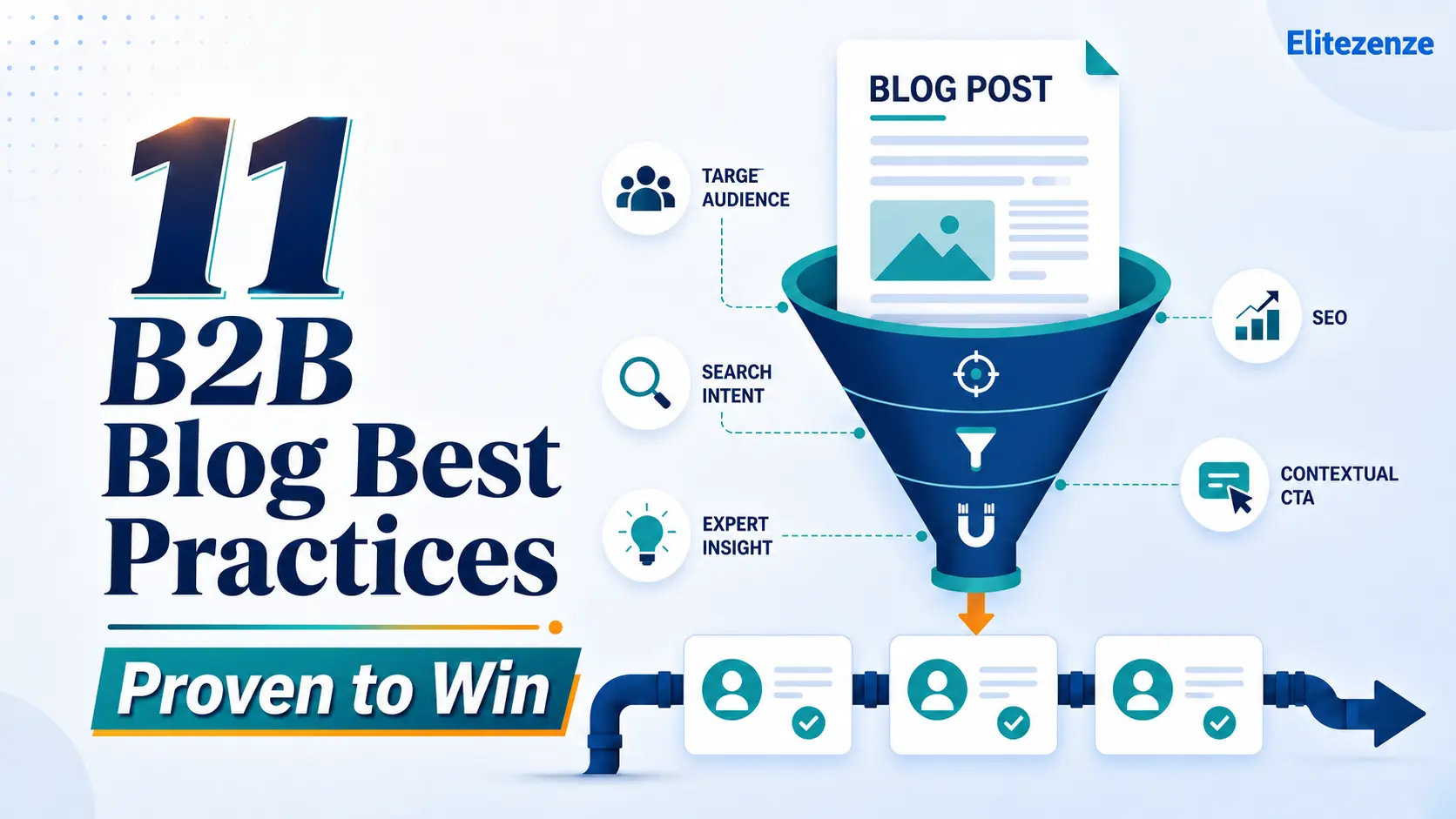
A productive B2B blog can be understood through five connected elements:
- Audience: Who is the article meant to help?
- Intent: What question or decision brought that person to the page?
- Expertise: What useful insight can your company contribute?
- Conversion: What should the reader do next?
- Measurement: Did the content influence a meaningful business result?
If one element is missing, performance suffers. Strong SEO without expertise produces generic content. Strong expertise without distribution remains invisible. High traffic without an appropriate conversion path rarely creates qualified leads.

1. Tie Your B2B Blog Strategy to a Business Goal
Many blogging plans begin with an arbitrary commitment such as, “We will publish three posts every week.”
That is a production target, not a business strategy.
Before choosing topics or creating a content calendar, decide what the blog is expected to accomplish. Its primary purpose might be to:
- Increase non-branded organic visibility
- Generate demand for an unfamiliar solution
- Capture qualified leads
- Support sales conversations
- Educate current customers
- Establish thought leadership
- Reduce repetitive support questions
You can pursue more than one outcome, but every article should have a clear primary role. An awareness article should not be judged by the same standard as a product-comparison page.
Match Goals With Relevant Metrics
Use metrics that reflect the article’s actual purpose.
| Blog goal | Relevant measurements |
|---|---|
| Search visibility | Impressions, rankings and non-branded clicks |
| Audience engagement | Engaged sessions, scroll depth and returning visitors |
| Lead generation | Form completions and qualified lead volume |
| Sales influence | Opportunities, assisted conversions and pipeline value |
| Customer education | Product adoption and support-ticket reduction |
| Thought leadership | Branded searches, citations and sales usage |
This prevents a common reporting mistake: celebrating traffic on content that was supposed to produce qualified inquiries.
For each planned article, complete this sentence:
We are creating this article for [specific audience] to help them [solve a defined problem], and we will measure success through [relevant result].
That single statement can improve topic selection, writing, calls to action, and reporting.
2. Research the Entire B2B Buying Committee
A generic persona such as “marketing manager at a growing company” is rarely detailed enough to guide a strong content strategy.
The same purchase may be examined by several stakeholders:
- An end user wants an easier workflow.
- A department head wants better team performance.
- A technical evaluator wants compatibility and security.
- A finance leader wants a defensible cost.
- An executive sponsor wants a strategic outcome.
- Procurement wants acceptable terms and manageable risk.
Your blog should not force all those people into one fictional personality. Instead, identify the questions each role asks during the buying process.
Collect Real Voice-of-Customer Evidence
The most valuable topic ideas often exist inside the business already. Review:
- Sales-call notes and recordings
- Customer interview transcripts
- Support tickets
- Product reviews
- Search Console queries
- Live-chat conversations
- Community discussions
- Proposal questions
- Lost-deal feedback
- Customer onboarding calls
Look for repeated language. A phrase used by ten prospects is usually more valuable than clever terminology invented during a marketing meeting.
For example, your product team might describe a feature as “automated multichannel workflow orchestration.” Buyers may simply ask, “Can this stop my team from entering the same information twice?”
The second phrase is more natural, specific, and useful as the basis of an article.
Turn Buyer Questions Into Topics
Use this formula:
Buyer role + urgent problem + decision stage + desired outcome
Examples include:
- How finance teams can calculate the cost of manual data entry
- CRM migration questions IT leaders should ask before approval
- How operations managers compare workflow automation platforms
- A practical implementation timeline for first-time software buyers
These topics are stronger than broad ideas such as “The future of automation” because they connect a defined reader with a real decision.
3. Map Content to Every Stage of the Buyer Journey
Not every visitor is ready to book a sales call.
Some readers are only beginning to understand a problem. Others are comparing methods, building an internal business case, or choosing between vendors. Your B2B content strategy should support each stage without pushing every visitor toward the same action.
Top-of-Funnel Content Builds Problem Awareness
Early-stage readers need education, not a product pitch.
Useful formats include:
- Beginner guides
- Definitions and explanations
- Industry trend analysis
- Original research
- Diagnostic checklists
- “Why this happens” articles
- Common mistake guides
An appropriate CTA might invite them to read a related guide, subscribe to a newsletter, or download a practical checklist.
Middle-of-Funnel Content Helps Buyers Evaluate Approaches
At this stage, readers understand the problem but may not know which solution is right.
Useful formats include:
- Frameworks
- Templates
- Case studies
- Process breakdowns
- Implementation guides
- Cost explainers
- Webinars
- Solution-category comparisons
A suitable next step could be a case study, workshop, assessment, or implementation resource.
Bottom-of-Funnel Content Supports a Purchase Decision
High-intent readers need specific information that helps them compare options and reduce risk.
Useful content includes:
- Product comparisons
- Alternative pages
- Use-case articles
- Pricing explanations
- Integration guides
- Implementation timelines
- Security documentation
- ROI evaluation frameworks
At this stage, a consultation, trial, audit, or product demonstration may be appropriate.

| Buyer stage | Typical intent | Useful content | Suitable CTA |
| Awareness | Understand a problem | Guides, research and checklists | Read, subscribe or download |
| Evaluation | Compare approaches | Frameworks, cases and webinars | Assess, compare or attend |
| Decision | Select a provider | Comparisons, pricing and implementation | Trial, consult or request a demo |
4. Target Search Intent, Not Just Keyword Volume
A keyword with high search volume is not automatically valuable.
The better question is: Why is the person searching, and could that reason eventually connect with what the business offers?
Compare these two searches:
- What is workflow automation?
- Best workflow automation software for accounting teams
The first query may attract more visitors, but the second reveals a narrower audience and stronger commercial intent.
Identify the Decision Behind the Search
Before drafting, classify the query:
- Informational: The reader wants to understand something.
- Problem-aware: The reader recognises an issue but not the solution.
- Solution-aware: The reader is exploring possible approaches.
- Commercial investigation: The reader is comparing products or providers.
- Transactional: The reader is ready to take action.
Then examine the current search results. Look at the formats Google favours, the depth readers appear to expect, and the questions competitors leave unanswered.
Do not copy the existing results. Use them to understand the minimum expectations, then add something more useful.
Score Topics by Business Relevance
Evaluate each keyword against five criteria:
- Is the topic closely connected to our expertise?
- Does it address a real customer problem?
- Can we provide a better or more specific answer?
- Could the reader eventually need our solution?
- Do we have evidence, experience, or examples competitors lack?
A low-volume query that attracts the right decision-makers may create more value than a broad term that produces thousands of irrelevant sessions.
Build Topic Clusters
A topic cluster organises related articles around a comprehensive pillar page.
For example, a B2B lead-generation cluster might include:
- B2B lead-generation strategy
- How to qualify inbound leads
- B2B landing-page best practices
- Lead-nurturing email examples
- How to measure cost per qualified lead
- Marketing-qualified lead versus sales-qualified lead
Each supporting page should answer a distinct question and link naturally to related resources. This helps readers continue their research without returning to the search results.
5. Publish Original, Expert-Led Content
A summary of other articles is easy to create—and easy for competitors to replace.
Google’s guidance on helpful, people-first content encourages original reporting, research, analysis, clear sourcing, and evidence of first-hand expertise. It also asks whether a page provides substantial value compared with other search results. It does not require a large research budget. It can come from practical experience.
Interview Subject-Matter Experts
Instead of asking an expert to “explain the topic,” ask questions that uncover useful detail:
- Which mistakes do you see repeatedly?
- What advice in this industry do you disagree with?
- What warning signs should buyers notice?
- Which step is usually harder than expected?
- What changes the cost or timeline?
- What do successful customers do differently?
- Which question should buyers ask but rarely do?
Record the interview, verify the transcript, and use the expert’s comments to shape the argument. Do not add invented quotations or polish a statement until it no longer reflects what the person meant.
Add Evidence Competitors Cannot Easily Reproduce
Useful first-party material may include:
- Anonymised customer patterns
- Internal benchmarks
- Original diagrams
- Tested templates
- Process screenshots
- Survey findings
- Mini case studies
- Lessons from failed campaigns
- Before-and-after workflow comparisons
- Conversion data with an explained methodology
The 2025 Edelman–LinkedIn report also emphasises the role of perspective-shifting thought leadership in reaching visible and hidden members of B2B buying groups. article should not merely confirm what readers already know. It should help them see the problem more clearly or make a better decision.
Make the Source of Expertise Visible
Trust signals should include:
- A named author
- A useful author biography
- Relevant professional experience
- A reviewer when specialist verification is needed
- Publication and update dates
- Links to supporting sources
- A clear distinction between evidence and opinion
Do not describe a writer as an expert unless the biography demonstrates why that description is justified.
6. Make Every B2B Blog Post Easy to Scan
Business readers are often researching between meetings, comparing several providers, or gathering information for someone else. They need to understand the page quickly.
Start with a direct answer rather than a long introduction about how rapidly the industry is changing.
Use an Answer-First Structure
A practical sequence is:
- State the problem.
- Give the clearest answer.
- Explain how it works.
- Add evidence or an example.
- Show the reader what to do.
- Offer an appropriate next step.
This structure serves both readers who want a quick answer and those who need detailed support.
Improve Visual Readability
Use:
- Descriptive H2 and H3 headings
- Short paragraphs
- Bullets for genuinely scannable information
- Tables for comparisons
- Numbered steps for processes
- Bold text for key takeaways
- Diagrams for complex relationships
- Enough white space around visual elements
Avoid splitting every sentence into a separate paragraph. That can feel as unnatural as a dense wall of text.
Headings should tell the reader what the section explains. “Optimize CTAs for Buyer Intent” is more useful than “Boost Your Results.”
Remove Corporate Language
Phrases such as “revolutionary end-to-end solution” or “unlock unprecedented growth” make B2B writing less credible unless the claim is supported by clear evidence.
Replace inflated language with specifics:
- What does the product change?
- Who benefits?
- How does the process work?
- What evidence is available?
- What limitation should the reader understand?
Clear language sounds more confident than exaggerated language.
7. Apply B2B Blog SEO Best Practices Naturally
SEO should make useful content easier to discover and understand. It should not make the article sound as though it was written for a ranking system.
Google recommends using the language searchers use and placing descriptive terms in prominent locations, including titles, main headings, alt text, and link text. It also warns against keyword stuffing. Optimise the Core Page Elements
Place the primary phrase naturally in:
- The SEO title
- The H1
- The URL
- The opening section
- One relevant subheading
- The meta description
- One image alt attribute, when accurate
- The conclusion
Use secondary phrases only when they improve meaning. Variations such as “B2B blogging strategy,” “B2B content strategy,” and “blog lead generation” can support the topic without repeating the exact keyword unnaturally.
There is no useful reason to chase a fixed keyword density.
Strengthen Internal Linking
Internal links should help readers answer the next logical question.
A guide about B2B blogging might link to:
- A keyword-research tutorial
- A buyer-persona template
- A content-calendar guide
- A conversion-rate optimisation article
- A lead-generation checklist
- A content measurement framework
Use descriptive anchor text. “Learn how to conduct B2B keyword research” gives more context than “click here.”
Use External Links Selectively
Link to primary research, official guidance, or a reliable source that adds evidence. Two or three useful references are better than a long list added only to make the article appear researched.
Check external links during every meaningful content update. Remove or replace sources that are outdated, inaccessible, or no longer support the claim.
Optimise Images and Page Experience
For each image:
- Use a descriptive file name.
- Add accurate, concise alt text.
- Compress the file.
- Serve an efficient format such as WebP or AVIF where supported.
- Define width and height to reduce layout movement.
- Confirm text remains readable on mobile.
- Avoid placing essential information only inside the image.
A visually attractive infographic is not useful when its text becomes unreadable on a phone.
8. Match Every Call to Action to Search Intent
A person reading a beginner guide is rarely ready for the same action as someone comparing vendors.
Yet many B2B blogs place “Book a demo” after every article. This creates unnecessary friction and ignores the reader’s stage.
Use Low-Friction CTAs for Early-Stage Readers
Examples include:
- Download the checklist
- Read the next guide
- Subscribe for practical updates
- Use a free template
- Take a short assessment
These actions let readers continue learning without making a large commitment.
Use Evaluation CTAs for Middle-Stage Readers
Examples include:
- Read a customer case study
- Attend a product-neutral webinar
- Download an implementation guide
- Compare possible approaches
- Request a personalised assessment
The goal is to help the reader evaluate the problem and available solutions.
Use Commercial CTAs for High-Intent Readers
Examples include:
- Request an audit
- Start a trial
- Book a consultation
- Review implementation options
- Schedule a product demonstration
Place CTAs at natural decision points rather than interrupting every few paragraphs.
A sensible structure might include:
- One contextual link in the first third
- One relevant resource after a detailed section
- One primary CTA at the end
The CTA should feel like the next useful step, not a sudden sales demand.
9. Promote Each Article Beyond Google Search
Publishing is the beginning of distribution, not the end.
A strong article can support several channels and teams when it is planned as a reusable content asset.
Build the Distribution Plan Before Publishing
Ask:
- Which audience segment needs this?
- Where does that audience already spend time?
- Which sales conversations could the article support?
- Which partners or experts contributed to it?
- Which insight can stand alone on social media?
- Which section could become an email or visual?
Possible distribution channels include:
- Email newsletters
- Employee advocacy
- Sales follow-up
- Partner newsletters
- Customer communities
- Relevant industry groups
- Webinars
- Retargeting campaigns
Do not post the same promotional sentence everywhere. Adapt the idea to the channel.
Repurpose the Insight, Not Just the Link
One detailed blog post can become:
- A LinkedIn carousel
- A short executive viewpoint
- A sales follow-up email
- A newsletter section
- A webinar discussion
- A short educational video
- A checklist
- A presentation slide
- A customer onboarding resource
Each format should deliver standalone value. “New post—read it here” gives the audience little reason to stop scrolling.
Distribution also creates feedback. Comments, replies, objections, and sales questions can reveal what the original article should clarify during its next update.
10. Refresh, Consolidate, and Repurpose Older Posts
A B2B blog is a content library, not an endless timeline.
Older posts may already have backlinks, rankings, internal links, and historical authority. Updating the right article can be more valuable than creating another page on an overlapping subject.
Identify Content That Needs Attention
Look for pages with:
- Declining organic clicks
- Falling rankings
- Deep impressions but poor click-through rates
- Outdated screenshots or recommendations
- Broken links
- Weak conversions
- Thin or incomplete sections
- Several competing pages targeting the same intent
- Traffic that does not match the intended audience
Then choose the appropriate action.
Use the Four-Action Content Audit
Update: Correct old information, improve examples, and strengthen weak sections.
Expand: Add missing questions, evidence, stakeholder views, or practical steps.
Merge: Combine overlapping pages into one stronger resource and redirect the weaker URLs.
Remove or redirect: Retire content that is inaccurate, irrelevant, or impossible to improve.
Do not change the publication date merely to make an old article appear new. Google’s people-first guidance specifically warns against changing dates when content has not been substantially updated. Serve What Already Works
Before rewriting a page, identify:
- Sections earning featured visibility
- Keywords already producing qualified visits
- Backlinks pointing to the URL
- Internal links supporting the page
- Converting calls to action
- Examples that readers mention or share
Improve the page without carelessly removing its strongest assets.
11. Measure Pipeline Impact, Not Just Pageviews
Traffic is useful, but it is only one part of performance.
A complete measurement system connects search visibility, on-page behaviour, lead capture, qualification, and sales outcomes.
Track Search Visibility
Useful indicators include:
- Organic impressions
- Average search position
- Non-branded clicks
- Click-through rate
- New ranking queries
- Growth in relevant topic clusters
These metrics show whether the content is becoming easier to discover.
Track Engagement and Conversion
Measure:
- Engaged sessions
- Scroll depth
- CTA clicks
- Resource downloads
- Form completions
- Visitor-to-lead conversion rate
- Returning visitors
- Leads by landing page
Engagement metrics require context. A high scroll depth is encouraging, but it does not prove that the visitor was qualified or persuaded.
Connect Content With CRM Outcomes
Where your systems allow it, connect blog activity with:
- Marketing-qualified leads
- Sales-qualified leads
- Opportunities created
- Opportunities influenced
- Pipeline value
- Closed revenue
- Time from first visit to conversion
- Assisted conversions
The latest CMI research found that measuring content effectiveness remains a leading challenge for B2B marketers. It also found that relevance and content quality were among the most frequently cited factors behind effective marketing programs. Documented Lead Result
On our own site, the clearest business result was an increase in qualified lead volume. We verified the improvement through conversion data rather than relying only on traffic.
Before publishing, add the exact evidence here:
Qualified lead volume increased from [baseline number] to [new number] between [starting date] and [ending date]. During the same period, the visitor-to-lead conversion rate changed from [baseline rate]% to [new rate]%. We measured the result using [analytics or CRM platform] and counted a qualified lead as [your qualification definition].
Include any relevant context. For example, state whether you also changed the offer, forms, paid promotion, site design, or lead-qualification rules during the period. This prevents the article from giving the blog full credit when several factors contributed.
Create a Monthly Improvement Loop
Use a simple process:
Measure → diagnose → update → redistribute → compare
If a page attracts the correct audience but converts poorly, review the CTA and offer.
If it ranks but attracts irrelevant visitors, reassess the target query.
If it converts well but receives little visibility, strengthen internal links, distribution, and supporting content.

Common B2B Blogging Mistakes That Cost Leads
Even well-written content can underperform when the strategy behind it is weak.
Publishing Generic Search-First Content
An article that merely rearranges information from the first page of Google gives readers no reason to trust or remember the publisher.
Add experience, evidence, examples, a framework, or a defensible opinion.
Writing Only About the Company
A blog is not a collection of extended advertisements.
Product announcements and company news have a place, but buyers also need help understanding problems, comparing methods, reducing risk, and building internal support.
Targeting Traffic With No Commercial Relevance
A popular topic may attract a large audience that never needs your expertise.
Before approving a keyword, explain how the searcher’s problem relates to the audience your business serves.
Publishing More Instead of Publishing Better
A demanding schedule can lead to repetitive articles, weak research, rushed editing, and poor distribution.
Publishing fewer strong pieces may produce more value than filling a calendar with interchangeable posts.
Using Unsupported Claims
Avoid claims such as:
- Guaranteed to increase leads
- Proven to rank number one
- The best strategy for every company
- Instant pipeline growth
- A specific conversion improvement without accessible data
Use measured language and explain the evidence behind results.
Measuring Vanity Metrics Alone
Pageviews, impressions, and social reactions are useful diagnostic signals. They are not a substitute for qualified conversions, opportunities, and revenue-related outcomes.
A Practical 90-Day B2B Blog Improvement Plan
A complete transformation does not need to happen at once.
Days 1–30: Research and Audit
- Define one primary blog goal.
- Review the ideal customer profile.
- Map visible and hidden buying stakeholders.
- Interview sales, support, and customer-success teams.
- Audit existing articles.
- Identify overlapping or outdated pages.
- Select one commercially relevant topic cluster.
- Establish baseline traffic and conversion metrics.
Days 31–60: Create and Optimise
- Improve or publish one pillar article.
- Create two to four supporting pieces.
- Interview a subject-matter expert.
- Add an original diagram or framework.
- Strengthen internal links.
- Create CTAs for different intent levels.
- Review titles, headings, metadata, and image accessibility.
- Confirm every factual claim has an appropriate source.
Days 61–90: Distribute and Measure
- Repurpose the strongest insights.
- Share content through LinkedIn and email.
- Give relevant articles to the sales team.
- Track search, engagement, and conversion performance.
- Compare results with the original baseline.
- Update weak introductions or CTAs.
- Document what worked and what failed.
- Use those findings to plan the next cluster.
The purpose of the 90-day plan is not to prove that blogging works in exactly three months. It is to create a repeatable process with enough measurement to make better decisions.
Frequently Asked Questions About B2B Blog Best Practices
What are the most important B2B blog best practices?
The most important practices are understanding the full buying committee, targeting meaningful search intent, publishing expert-led information, making articles easy to navigate, using relevant calls to action, distributing content beyond search, and connecting performance with qualified leads and sales outcomes.
How often should a B2B company publish blog posts?
Publish at a frequency your team can sustain without sacrificing research, editing, subject expertise, and distribution. A useful monthly article can outperform several rushed weekly posts. Choose a schedule based on available resources, competitive demand, and the time required to create something meaningfully better than existing results.
How do B2B blogs generate qualified leads?
A B2B blog generates leads by attracting people with relevant business problems, helping them make progress, building confidence in the publisher’s expertise, and presenting a next step suited to their buying stage. The lead must then be qualified and nurtured rather than counted as valuable simply because a form was submitted.
What makes a good B2B blog post?
A good B2B post has a clearly defined reader, a specific problem, a direct answer, practical evidence, logical headings, natural search optimisation, and an appropriate next action. It should add insight that a reader could not obtain by scanning several generic summaries of the same subject.
How long should a B2B blog post be?
The appropriate length depends on the question and the detail needed to answer it. Some queries can be satisfied in 1,000 words, while a complex strategic guide may need 3,000 words or more. Google explicitly states that it does not have a preferred word count, so completeness matters more than length. h B2B blog metrics matter most?
The most useful metrics depend on the article’s goal. For lead generation, monitor qualified conversions, visitor-to-lead rate, lead quality, opportunities influenced, and pipeline contribution. Use rankings, clicks, and engagement metrics to diagnose performance, but do not treat them as final business outcomes.
Should every B2B blog post include a call to action?
Most articles should give readers a logical next step, but that step does not always need to be a sales request. An early-stage article may link to a guide or checklist, while a high-intent comparison may appropriately offer a trial, consultation, or demonstration.