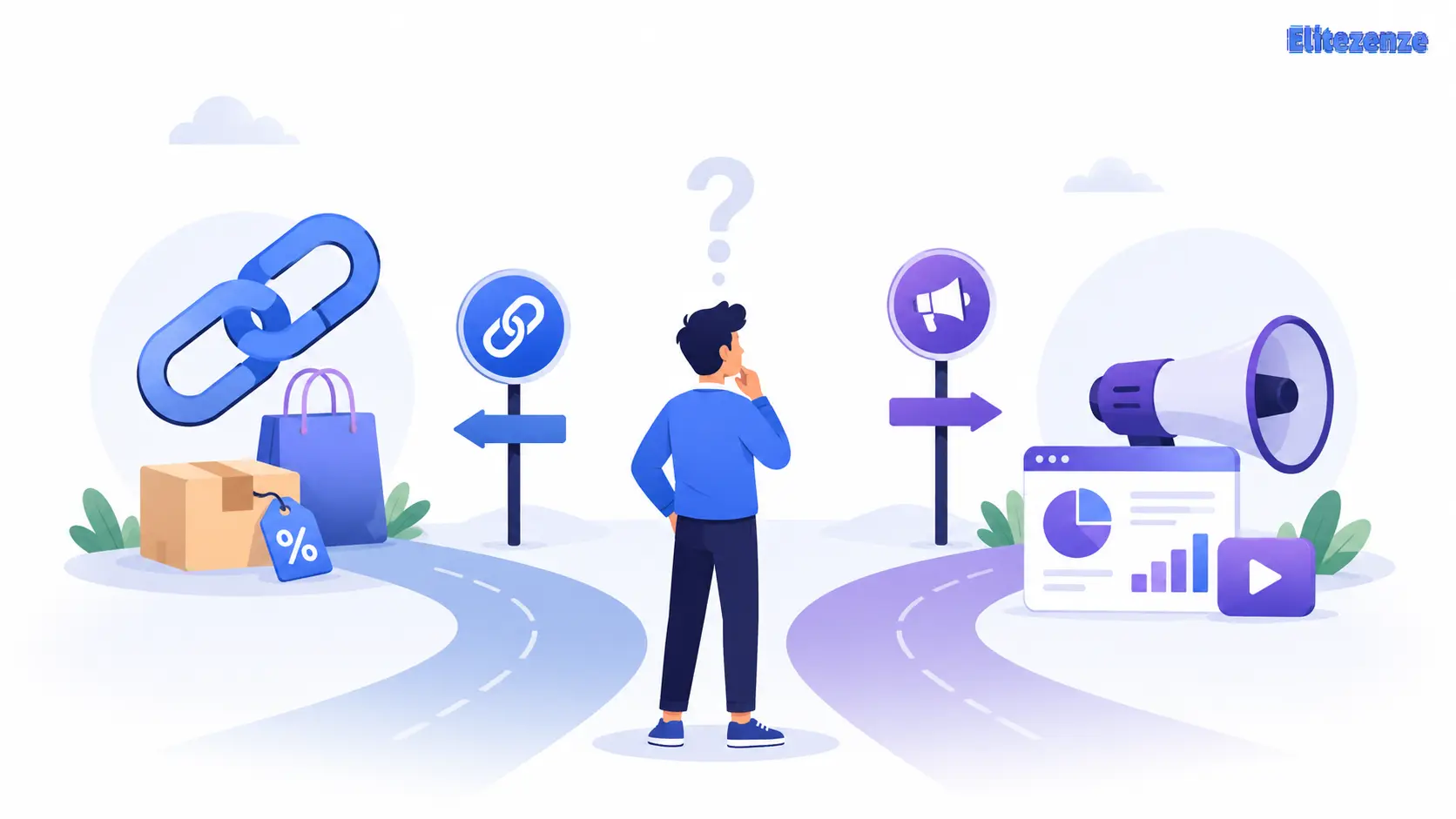
Affiliate marketing and digital marketing are often presented as two competing ways to make money online. That comparison sounds reasonable because both involve content, online promotion, customer attention, and sales.
There is one problem: they are not equal categories.
Digital marketing is a broad discipline covering the methods businesses use to reach and convert customers through digital channels. Affiliate marketing is a performance-based model in which a publisher, creator, or partner earns a commission for generating a sale, lead, or another agreed action.
In other words, one is a complete marketing ecosystem. The other is a specific way to earn revenue or acquire customers within that ecosystem.
This distinction matters whether you are a beginner choosing a career, a creator hoping to monetize an audience, a freelancer developing a service, or a business owner deciding where to invest.
This guide compares affiliate marketing vs digital marketing across startup costs, required skills, income potential, control, ownership, career options, and long-term risk. It will also help you decide whether you should choose one or combine both.
Affiliate Marketing vs Digital Marketing: The Quick Answer
Digital marketing is the broader practice of using websites, search engines, email, social media, paid advertising, content, and other digital channels to attract and retain customers.
Affiliate marketing is a performance-based arrangement within that broader field. An affiliate promotes another company’s product or service and receives a commission when a tracked visitor completes a qualifying action.
Choose digital marketing when you want broad professional skills, control over a brand, several career paths, or the ability to market your own products.
Choose affiliate marketing when you want to monetize content or an audience without developing, fulfilling, and supporting your own product.
For many creators and businesses, the most practical answer is to use both.
What Are Digital Marketing and Affiliate Marketing?
Before comparing them, it helps to define what each term actually means.
What Is Digital Marketing?
Digital marketing is the use of electronic and online channels to communicate with potential customers, create demand, generate leads, drive sales, and maintain customer relationships.
The American Marketing Association’s digital marketing overview describes digital marketing as marketing conducted through electronic devices and channels such as websites, search engines, blogs, video, email, and social media. It also identifies affiliate marketing as one of several digital marketing methods.
Common digital marketing channels include:
- Search engine optimization
- Content marketing
- Email marketing
- Social media marketing
- Paid search and PPC advertising
- Display advertising
- Video marketing
- Influencer marketing
- Affiliate marketing
- Conversion rate optimization
- Marketing automation
Digital marketing may be a department inside a company, a career, a freelance service, an agency offering, or the growth system behind an online business.
A digital marketer might promote:
- Their own company
- An employer’s products
- A client’s services
- A nonprofit organization
- A personal brand
- A third-party affiliate offer
The main objective varies. One campaign might aim to increase brand awareness, while another is designed to collect leads, sell products, encourage app installations, or retain existing customers.
What Is Affiliate Marketing?
Affiliate marketing is an arrangement between a merchant and an independent promoter, usually called an affiliate or publisher.
The affiliate recommends the merchant’s product through content, advertising, email, social media, video, or another approved channel. The affiliate receives a commission when someone completes a tracked action.
A typical affiliate transaction involves four participants:
- Merchant: The company that owns the product or service.
- Affiliate: The person or publisher promoting the offer.
- Customer: The person who clicks the referral link and completes an action.
- Network or tracking platform: The system that records clicks, conversions, and commissions.
The process generally works like this:
- The publisher joins an affiliate program.
- The program provides a unique referral link.
- The publisher shares the offer with a relevant audience.
- A visitor clicks the link.
- The visitor purchases, registers, or completes another qualifying action.
- The publisher earns a commission.
Affiliate programs may pay for:
- Completed sales
- Qualified leads
- Free-trial registrations
- App installations
- Subscription renewals
- Other predefined actions
This is why affiliate marketing is often described as performance-based marketing. Payment depends on a measurable result rather than the number of hours the affiliate works.
Is Affiliate Marketing Part of Digital Marketing?
Yes. Affiliate marketing is usually considered part of digital marketing because affiliates rely on digital channels to attract attention and generate conversions.
However, affiliate marketing is more than a promotional channel. It is also a commercial relationship and compensation model.
Digital marketing explains how an audience is reached and persuaded. Affiliate marketing explains how the promoter and merchant work together and how the promoter is paid.
Not every digital marketer is an affiliate. A company’s email marketer, for example, might only promote that company’s products. Successful affiliates, however, generally use at least one digital marketing skill, such as SEO, copywriting, video, email, social media, or paid advertising.

Digital Marketing vs Affiliate Marketing Comparison
The following table provides a quick overview. These are common patterns rather than strict rules.
| Factor | Affiliate Marketing | Digital Marketing |
|---|---|---|
| Scope | Specialized business and payment model | Broad marketing discipline |
| Main goal | Earn commissions or produce partner sales | Build awareness, leads, sales, or retention |
| Product ownership | Usually promotes third-party products | May promote owned, employer, or client products |
| Primary income | Performance-based commissions | Salary, fees, retainers, sales, or commissions |
| Startup cost | Usually low, but not always | Can range from almost free to expensive |
| Control | Limited after the referral | Greater control over the offer and funnel |
| Customer relationship | Usually indirect | Often direct |
| Required skills | Content, traffic, trust, and conversion | Wider multichannel marketing skills |
| Speed to start | Often faster | May require more planning and infrastructure |
| Long-term assets | Depends on whether the affiliate owns the audience | Can build a brand, customer list, and first-party data |
| Main risks | Merchant, platform, and commission dependency | Campaign, budget, operational, and market risk |
| Best suited to | Creators, publishers, reviewers, and niche sites | Brands, professionals, agencies, and freelancers |
The most important difference between affiliate marketing and digital marketing is not the platform being used. Both may use the same website, email list, search engine, or social account.
The real differences are ownership, responsibility, payment, and control.
The 9 Shocking Truths About Affiliate Marketing vs Digital Marketing
Truth 1: They Are Not True Opposites
The phrase “affiliate marketing vs digital marketing” suggests that a person must choose between two equivalent options.
That is misleading.
Digital marketing describes a broad collection of strategies. Affiliate marketing describes one particular commercial model that may use those strategies.
Think of digital marketing as a toolbox. Inside it are tools for SEO, content, email, social media, paid advertising, analytics, and conversion optimization.
Affiliate marketing is one way of using those tools. The affiliate applies them to promote another company’s product and earn a commission.
A person may therefore practice digital marketing without doing affiliate marketing. An affiliate, by contrast, usually depends on digital marketing to attract and persuade an audience.
Simple takeaway: Digital marketing provides the methods. Affiliate marketing provides one way to monetize those methods.
Truth 2: Affiliate Marketing Is a Business Model, Not Just a Skill
Digital marketing can be learned and sold as a professional service.
A skilled digital marketer may earn money through:
- Employment
- Freelance projects
- Agency retainers
- Consulting
- Campaign management
- Content production
- Lead-generation services
- Sales of owned products
Affiliate marketing works differently. Affiliates are normally paid for results rather than for completing marketing tasks.
An affiliate could spend 20 hours creating a detailed comparison article and earn nothing if no visitor converts. A freelance writer might still be paid for producing that same article because the client purchased the writing service.
This difference changes the risk.
Service providers generally receive payment for agreed work. Affiliates carry more performance risk because their income depends on traffic, clicks, tracking, merchant conversion rates, and program rules.
That does not make one option better. It means they solve different problems.
Digital marketing is usually the stronger choice for someone seeking a transferable career. Affiliate marketing may be a better fit for a person who wants to build a publishing or audience-monetization business.
Truth 3: Low Startup Cost Does Not Mean Easy or Passive
Affiliate marketing has a low barrier to entry because affiliates do not normally need to:
- Design a product
- Purchase inventory
- Process payments
- Ship orders
- Handle returns
- Operate a customer-support team
Many affiliate programs are also free to join.
This makes affiliate marketing easier to start than a traditional retail business. It does not make it easy to succeed.
A new affiliate still needs to choose a suitable market, understand audience problems, find trustworthy products, create useful content, attract visitors, earn trust, test calls to action, and measure conversions.
Even content that performs well requires maintenance. Prices change. Products disappear. Affiliate programs close. Links break. Search rankings move. Competitors publish better resources.
For example, imagine that you publish an article comparing five project-management tools. Six months later, one company changes its pricing, another removes a feature, and a third cuts its commission rate.
The article is no longer fully accurate, even if it continues receiving traffic. Leaving it untouched could reduce reader trust and revenue.
Affiliate income may become less hands-on after a content library has been built, but it is rarely completely passive.
For affiliate marketing vs digital marketing beginners, this is an important reality: affiliate marketing may be cheaper to enter. In contrast,e digital marketing often provides a clearer path to paid employment or client work.
Truth 4: Not Owning the Product Is Both an Advantage and a Risk
Not creating a product can save months of work.
An affiliate can choose an existing offer, study the audience, create a useful recommendation, and begin promoting it. The merchant is responsible for manufacturing, delivery, billing, refunds, and customer support.
That flexibility is one of affiliate marketing’s main attractions.
The disadvantage is reduced control.
An affiliate may have little influence over:
- Product quality
- Pricing
- Checkout design
- Customer support
- Refund policies
- Landing-page performance
- Tracking accuracy
- Commission rates
- Program eligibility
A merchant can reduce commissions, change its attribution window, reject certain traffic sources, discontinue a product, or close the program.
A digital marketer working for an owned brand normally has more influence over the complete customer journey. The company can adjust its offer, pricing, messaging, landing pages, remarketing, customer support, and retention campaigns.
Consider two websites that both generate 10,000 monthly visitors.
The first promotes third-party software through affiliate links. The second sells its own software.
The affiliate website may be easier to operate, but the software owner controls the price, customer data, onboarding, renewals, and product roadmap. That control may create greater long-term value, although it also requires more work and financial risk.
Truth 5: Neither Model Is Automatically More Profitable
“Which one makes more money?” is one of the most common questions about affiliate marketing vs digital marketing.
There is no universal answer.
Affiliate revenue depends on several moving parts:
Traffic × affiliate-link click rate × merchant conversion rate × average order value × commission rate
Suppose an article receives 5,000 visits per month:
- 20% click an affiliate link
- 3% of those visitors buy
- The average order is $100
- The commission is 10%
The estimated revenue would be:
5,000 × 0.20 × 0.03 × $100 × 0.10 = $300
A small improvement at any stage can change the result. Better buyer intent may increase the click rate. A stronger merchant page may improve conversions. A higher-value product may increase the commission.
Several variables also influence digital marketing profitability:
Marketing ROI = (attributable revenue − marketing cost) ÷ marketing cost × 100
If a business spends $5,000 on a campaign and attributes $8,000 in revenue to it, the simple marketing ROI is 60%. That calculation still needs context because revenue is not the same as profit. Product costs, salaries, software, refunds, and operating expenses also matter.
Affiliate marketing may be profitable for a small publisher with modest expenses. Digital marketing may create more total value when it builds a brand, customer list, recurring revenue, and proprietary assets.
The right comparison is not “Which model produces the biggest revenue screenshot?”
A better question is:
Which approach creates the strongest return after accounting for costs, time, risk, ownership, and long-term value?

Truth 6: Digital Marketing Offers More Career Paths
Digital marketing is a broad field, which creates several employment and freelance options.
A person can specialize as a:
- Search engine optimization specialist
- Content strategist
- Paid media manager
- Email marketer
- Social media manager
- Marketing analyst
- Conversion optimization specialist
- Copywriter
- Marketing automation specialist
- Digital marketing strategist
These skills can be used inside companies, at agencies, as a freelancer, or in a personal business.
Affiliate marketing is more commonly an income model within:
- A niche website
- A review publication
- A creator business
- A newsletter
- A video channel
- A comparison platform
- A performance-marketing agency
Affiliate management can also be a career. Companies hire affiliate managers to recruit partners, review applications, monitor compliance, support publishers, and improve program performance.
However, a beginner who wants a dependable career path will usually benefit from learning digital marketing fundamentals first. Those skills can later be applied to affiliate marketing.
For example, learning SEO can help you qualify for a marketing role while also helping you build a niche affiliate website. Learning email marketing can help you serve clients and nurture an audience for relevant affiliate offers.
The underlying skill creates more options than the monetization model alone.
Truth 7: Both Require Nearly the Same Core Skills
Affiliate marketing is sometimes presented as little more than copying a referral link and posting it online.
That approach rarely produces sustainable results.
People do not click and purchase simply because a link exists. They act when the recommendation is relevant, credible, well explained, and presented at the right time.
Both affiliate marketers and digital marketers need skills such as:
- Audience research
- Search-intent analysis
- Copywriting
- Content creation
- SEO
- Email marketing
- Social media distribution
- Landing-page analysis
- Conversion tracking
- Analytics
- Testing
- Trust building
The difference is how those skills are applied.
A company’s content strategist may create an article to generate leads for an owned service. An affiliate publisher may create a similar article to recommend a third-party service.
Both need to understand the reader’s problem. Both need to explain the available options. Both need to guide the reader toward a sensible next step.
The payment model changes, but the fundamentals of effective communication do not.
Truth 8: Owned Assets Matter More Than Follower Counts
A large following can be useful, but audience size does not equal business security.
There is a significant difference between owned assets and borrowed access.
Owned or partially controlled assets include:
- A website
- An email list
- Original research
- A recognizable brand
- A private community
- Customer data collected with permission
- Proprietary products
- A library of useful content
Borrowed assets include:
- Social media reach
- Marketplace visibility
- Search rankings
- Affiliate-program access
- Third-party tracking systems
- A merchant’s conversion funnel
A creator with 100,000 followers may lose much of their reach after a platform changes its recommendation system. An affiliate publisher may lose revenue if a merchant closes its program. A business relying entirely on paid ads may struggle when acquisition costs rise.
This does not mean platforms should be avoided. It means they should be used to support assets you control.
A practical approach is to use search and social media for discovery, then encourage interested readers to join an email list, visit a website, or become part of a community.
Ownership also affects affiliate compliance and trust.
When a recommendation can produce a commission, readers should be told about that relationship. The FTC endorsement guidance says affiliate relationships should be disclosed clearly and conspicuously, preferably close to the recommendation or link. It also warns that a label such as “affiliate link” may not clearly explain that the publisher can earn money from a purchase.
A straightforward disclosure might say:
This article contains affiliate links. If you purchase through one of these links, we may earn a commission at no additional cost to you.
Do not hide the disclosure on an About page, at the bottom of a long article, or behind a “read more” button. FTC guidance recommends placing disclosures where they are difficult to miss and using simple language that readers can understand.
Transparency is not only a compliance matter. It gives readers the context needed to judge a recommendation fairly.
A 2026 academic study examining a 10-year dataset of two million YouTube videos reported that affiliate links were widespread while disclosure compliance remained low. The researchers argued that clearer platform tools and stronger cooperation among advertisers, platforms, and regulators could improve transparency.
Truth 9: The Strongest Strategy Often Uses Both
Affiliate marketing and digital marketing can support each other rather than compete.
A creator might use:
- SEO to attract people searching for solutions
- Content to explain the problem
- Video to demonstrate a product
- Email to maintain the relationship
- Analytics to understand reader behavior
- Affiliate links to monetize relevant recommendations
A business can take the opposite perspective.
It can use its website, content, email list, and paid campaigns to build its brand while creating an affiliate program that allows independent publishers to promote its products.
Here is a simple creator example.
A photographer publishes tutorials about editing images. The tutorials attract organic search traffic. Readers join an email list to receive editing tips. The photographer recommends suitable cameras, storage devices, editing software, and online courses through affiliate programs.
Digital marketing builds the audience. Affiliate marketing provides one source of revenue.
Now consider a software company.
The company publishes educational content, uses email to nurture leads, and runs paid search campaigns. It also recruits consultants and creators as affiliates. Those partners publish tutorials and comparisons that introduce the product to new audiences.
The company owns the offer. The affiliates expand its distribution.
The strongest model often uses digital marketing to build demand and affiliate partnerships to monetize or distribute relevant offers.
Which Is Better for You: Affiliate Marketing or Digital Marketing?
The better option depends on what you are trying to build.
Choose Affiliate Marketing If…
Affiliate marketing may suit you when:
- You want to begin without developing a product.
- You enjoy publishing reviews, tutorials, and comparisons.
- You already have a niche audience.
- You are comfortable with variable income.
- You want a relatively low-cost way to test a business idea.
- You are willing to depend partly on merchant programs.
- You can recommend products without compromising reader trust.
Affiliate marketing is especially practical for creators whose audience already asks for product recommendations.
A home-improvement blogger, for instance, may naturally recommend tools used in a tutorial. The recommendation helps the reader complete the project and can produce a commission for the publisher.
The offer should follow the audience’s need. Starting with the highest commission and then searching for an audience usually leads to weak content.
Choose Digital Marketing If…
Digital marketing is likely the better starting point when:
- You want a marketing job.
- You want to work with freelance clients.
- You plan to build your own business or brand.
- You want control over the offer and customer experience.
- You enjoy research, communication, analytics, and testing.
- You want several possible income paths.
- You prefer being paid for services rather than only for conversions.
It also provides a broader foundation. SEO, email, content, paid media, and analytics skills can be used in many industries.
Choose Both If…
Combining them makes sense when:
- You are building a creator-led business.
- You own a niche publication.
- You want to monetize educational content.
- You plan to launch your own product later.
- Your company wants performance-based distribution.
- You want affiliate income without depending on one merchant.
| Your main goal | Recommended starting point |
|---|---|
| Get a marketing job | Digital marketing |
| Become a freelancer | Digital marketing |
| Monetize an existing audience | Affiliate marketing |
| Promote a product you own | Digital marketing |
| Build an online brand | Digital marketing |
| Start without creating a product | Affiliate marketing |
| Build a creator business | Both |
| Expand a company’s sales channels | Both |

How to Combine Digital and Affiliate Marketing
Using both successfully requires more than filling articles with referral links.
Step 1: Choose a Specific Audience Problem
Begin with a problem, not a product.
Ask:
- Who is the reader?
- What are they trying to achieve?
- What is preventing them from achieving it?
- What information do they need before choosing a solution?
- What type of product could genuinely help?
“Productivity software” is too broad.
“Simple project-management software for a five-person design agency” is more useful because it describes a clear audience and situation.
Step 2: Build an Owned Content Platform
Choose a primary platform that allows you to publish useful content consistently.
Possible options include:
- A niche website
- An email newsletter
- A YouTube channel
- A podcast
- A professional social account
- A private community
A social account can help you get noticed, but a website or email list usually provides more control.
Step 3: Attract and Educate the Audience
Use digital marketing channels that match the audience’s behavior
SEO may work well for people actively researching a solution. Video may be better for demonstrations. Email can nurture readers who are interested but not ready to act.
Avoid trying to master every channel at once. A useful article and a small email list are more valuable than five abandoned social profiles.
Step 4: Add Relevant Affiliate Offers
Evaluate an offer before promoting it.
Consider:
- Audience relevance
- Product quality
- Merchant reputation
- Pricing
- Commission terms
- Refund rates
- Conversion experience
- Program restrictions
- Disclosure requirements
A high commission cannot compensate for a poor product. Recommending unsuitable offers may produce short-term clicks but damage long-term trust.
Step 5: Measure Meaningful Outcomes
Track more than page views.
Useful affiliate metrics include:
- Qualified traffic
- Affiliate-link click-through rate
- Merchant conversion rate
- Earnings per click
- Revenue per article
- Reversal or refund rate
- Revenue by merchant
- Email subscriber value
Also pay attention to concentration risk. If 90% of your income comes from one merchant or one article, the business is vulnerable.
Common Mistakes to Avoid
Treating Affiliate Marketing as Effortless Income
Publishing a link is easy. Building enough trust for someone to act on a recommendation is the difficult part.
Help the reader make a sound decision before thinking about commission.
Learning Tools Without Learning Strategy
Knowing where to click inside an advertising platform is not the same as understanding an audience.
Tools change. The ability to identify a problem, create a relevant offer, communicate value, and measure outcomes lasts longer.
Depending on One Merchant
A single commission change can significantly reduce income.
Where appropriate, compare several suitable providers and develop more than one revenue source.
Comparing Revenue Without Comparing Costs
A person earning $5,000 per month may spend $4,000 on advertising, writers, software, and contractors.
Another publisher may earn $2,000 with expenses of only $300.
Revenue screenshots rarely show the complete business.
Hiding Affiliate Disclosures
A vague disclosure buried at the bottom of an article does not help someone who has already clicked a recommendation.
Place clear language near the content or links that could produce a commission.
Publishing Thin Product Summaries
Copying a merchant’s description adds little value.
Google’s spam policies describe “thin affiliation” as affiliate content that repeats merchant descriptions without meaningful original information. Google gives original testing, comparisons, additional information, ratings, and useful navigation as examples of value that affiliate pages can add.
A strong affiliate article should explain:
- Who the product is for
- Who should avoid it
- The problem it solves
- Important limitations
- How it compares with alternatives
- The criteria used to evaluate it
- The circumstances in which it offers good value
Google’s people-first content guidance recommends original analysis, complete coverage, clear sourcing, demonstrable expertise, and content that leaves readers feeling they have learned enough to achieve their goal. It also states that Google has no preferred word count.
Do not make an article long simply to reach 3,500 words. Use the space to answer the reader’s next question before they need to return to the search results.
Frequently Asked Questions
What is the main difference between affiliate marketing and digital marketing?
Digital marketing is the broad practice of reaching and converting customers through digital channels. Affiliate marketing is a performance-based arrangement in which an independent partner promotes another company’s offer and earns a commission for a tracked result.
Digital marketing is the larger category; affiliate marketing is one model within it.
Is affiliate marketing considered digital marketing?
Yes. Affiliate marketing is normally considered part of digital marketing because affiliates use websites, search engines, email, video, advertising, and social media to promote offers.
However, it is also a compensation and partnership model because the affiliate is paid according to agreed results.
Which is better for beginners?
It depends on the beginner’s objective.
Someone seeking a job or freelance clients should usually learn digital marketing fundamentals first. Someone with an existing audience who wants to recommend relevant products may be able to start with affiliate marketing.
Learning digital marketing skills generally makes affiliate marketing easier to grow.
Which is more profitable, affiliate marketing or digital marketing?
Neither is automatically more profitable.
Affiliate profitability depends on traffic quality, click-through rates, merchant conversion rates, commissions, and operating costs. Digital marketing profitability depends on campaign costs, sales, margins, customer value, and attribution.
Ownership also matters. Selling your own product can produce more value per customer, but it requires more work and risk.
Is affiliate marketing easier than digital marketing?
Affiliate marketing may be easier to enter because you do not need to create a product or manage fulfillment
Building dependable traffic and income is still difficult. Affiliates need many of the same skills as other digital marketers, including content creation, SEO, persuasion, analytics, and conversion optimization.
Can I start affiliate marketing without a website?
Yes. Some programs allow promotion through YouTube, social media, email, podcasts, or online communities.
Each program has its own rules. A website can still be valuable because it gives you greater control over your content, search visibility, audience experience, and email-list growth.
Should I learn digital marketing before affiliate marketing?
Learning the fundamentals first is usually helpful.
Audience research, content creation, SEO, email marketing, copywriting, and analytics will help you attract better traffic and explain offers more effectively.
You do not need to master every discipline before joining a program. Start with one traffic channel and build from there.
Can a digital marketer also become an affiliate marketer?
Yes. Digital marketers can use their existing skills to build audiences and promote suitable third-party offers.
For example, an SEO specialist might create a niche resource site. An email marketer might operate a specialist newsletter. A video marketer might publish product demonstrations containing clearly disclosed affiliate links.
Can a business use digital marketing and affiliate marketing together?
Yes. A company can use owned digital channels to build its brand while recruiting affiliates to reach additional audiences.
The business controls its product and customer experience. Affiliates provide performance-based distribution through content, reviews, comparisons, communities, or other approved methods.
Is affiliate marketing passive income?
It can become less dependent on daily work after a strong content and traffic system has been built.
It still requires maintenance. Links, offers, disclosures, rankings, conversion rates, and program terms can change. Describing it as completely passive creates unrealistic expectations.
Final Verdict
The debate over affiliate marketing vs digital marketing becomes easier once you understand that they are not true opposites.
Digital marketing is the broader and more transferable discipline. It includes the strategies businesses and creators use to find audiences, communicate value, generate demand, and measure results.
Affiliate marketing is a focused performance-based model inside that discipline. It can offer a relatively low-cost way to monetize content because the affiliate does not need to create or fulfill the product. The trade-off is less control over pricing, tracking, commissions, and the customer experience.
Choose digital marketing when you want broad professional skills, a career, client work, or control over your own brand.
Choose affiliate marketing when you want to monetize a relevant audience without creating a product.
Choose both when you want to build an audience with digital marketing and earn revenue from carefully selected recommendations.